Advertisements
Advertisements
Question
The ear ossicle which is attached to the tympanum.
Advertisements
Solution
Malleus
RELATED QUESTIONS
Perilymph or endolymph (Which one surrounds the organ of Corti?)
Where is the Semicircular canals located? Briefly mention its function.
Differentiate between:
The middle ear and Inner ear.
The range of audible frequency for the human ear is
List the causes of noise pollution.
The median canal of cochlea is filled with ______.
Where are the following located?
Eustachian canal
Give reason:
Three small bones of ear ossicles are advantageous as compared to one single bone for hearing.
With reference to human ear answer the question that follow:
Name the part of the ear associated with the amplification of vibrations.
Given below is the diagram of a part of the human ear. Study the same and answer the questions that follow:
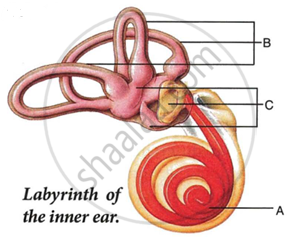 |
- Give the collective biological term for Malleus, locus and Stapes.
- Name the parts labelled A, B and C in the diagram.
- State the functions of the parts labelled 'A' and 'B'.
- Name the audio receptor region present in the part labelled 'A'.
