Advertisements
Advertisements
Question
State the utility of oxygen for respiration in plants
Advertisements
Solution
Respiration in plants:
- Plants respire during the day and night.
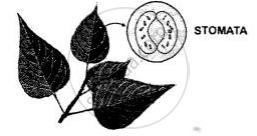
- Plants respire through tiny pores on the surface of the leaves called ‘stomata’.
- The stomata help in taking in the oxygen of the air and giving out carbon dioxide. Thus, they function as respiratory organs.
- Plants do not perform bodily activities and hence need less energy than animals. The rate of respiration in plants is thereby slower than in animals.
Photosynthesis in plants:
Photosynthesis is a process by which green plants prepare their own food in the presence of sunlight and chlorophyll.
- In the leaf of a green plant are present leaf cells which contain chloroplasts in which is present a green pigment called chlorophyll.
- During photosynthesis which occurs during daytime, carbon dioxide and water in the presence of sunlight and chlorophyll is changed into glucose, and oxygen is released out.
\[\ce{Carbon dioxide + Water ->[Sunlight][Chlorophy II]Glucose + Oxygen + Water}\] - Hence oxygen in the air is renewed by photosynthesis and therefore the amount of oxygen in the air does not get depleted or removed from the air.
RELATED QUESTIONS
What are the main components of air?
Give reason:
When water is heated, we see bubbles rising up.
Fill in the blanks
Oxygen is used in ___________the food to get _______.
Write ‘true’ or ‘false for the following;
The major component of air is oxygen.
Give word equation for the following conversion:
Nitric oxide to nitrogen dioxide
Give word equation for the following conversion:
Nitric acid to soluble nitrates in the soil
How do the roots of land plants get oxygen for breathing?
Why does a lump of cotton wool shrink in water?
What is the presence of harmful substance in the air called?
Give the components present in the air with a percentage?
