Advertisements
Advertisements
प्रश्न
State the utility of oxygen for respiration in plants
Advertisements
उत्तर
Respiration in plants:
- Plants respire during the day and night.
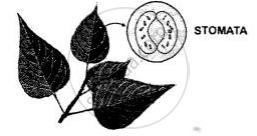
- Plants respire through tiny pores on the surface of the leaves called ‘stomata’.
- The stomata help in taking in the oxygen of the air and giving out carbon dioxide. Thus, they function as respiratory organs.
- Plants do not perform bodily activities and hence need less energy than animals. The rate of respiration in plants is thereby slower than in animals.
Photosynthesis in plants:
Photosynthesis is a process by which green plants prepare their own food in the presence of sunlight and chlorophyll.
- In the leaf of a green plant are present leaf cells which contain chloroplasts in which is present a green pigment called chlorophyll.
- During photosynthesis which occurs during daytime, carbon dioxide and water in the presence of sunlight and chlorophyll is changed into glucose, and oxygen is released out.
\[\ce{Carbon dioxide + Water ->[Sunlight][Chlorophy II]Glucose + Oxygen + Water}\] - Hence oxygen in the air is renewed by photosynthesis and therefore the amount of oxygen in the air does not get depleted or removed from the air.
संबंधित प्रश्न
Name the main components of air.
Statement given below is incorrect. Write the correct statement :
Potassium nitrate on strong heating decomposes into potassium nitrite and nitrogen gas.
Fill in the blank
The reddish-brown powder on the surface of iron nails exposed to air and moisture is called _____.
State a reason why there is a balance in the amount of carbon dioxide in the air, even though carbon dioxide is released into the atmopshere by various processes.
State whether the following statement is ‘true’ or ‘false’. If false write the correct statement.
The percentage of carbon dioxide in the air is between 0.2 to 0.4%.
Write about the reaction of nitrogen with non metals.
Composition of the component of air ______ from place to place.
What is the presence of harmful substance in the air called?
Venus's atmosphere consists of roughly 96 – 97% of ______.
A list of words is given in a box. Use appropriate words to fill up the blank in the following statement.
Mountaineers carry oxygen ______ with them, while climbing high mountains.
