Advertisements
Advertisements
Question
State the scientific and eco-friendly methods of waste management.
Advertisements
Solution
The scientific and eco-friendly methods of waste management are:
- Waste separation: This is the first step in waste management. Classification of dry waste and wet waste is very important for further processing of waste.
- Composting: Decomposing kitchen waste in small pits in the backyard, garden, or terrace is called composting. Good quality compost can be made by composting food scraps, fruit peels, vegetables, etc.
- Vermicomposting: In this method, solid waste is rapidly decomposed with the help of earthworms. Manure obtained from vermicomposting is useful for agriculture, as it is rich in nutrients.
- Secured landfill: In this method, the waste is kept in a special place safely away from human habitation. In such places, the ground is covered with plastic and clay so that the waste water does not seep into the ground.
- Pyrolysis: It is a method for solid waste management. It is the chemical decomposition of solid waste by heat under high pressure, and the end products of pyrolysis are used to produce steam and electricity.
- The combustion of the furnace/bhashimation: This is an industrial method in which the waste is converted into a simple solid or aerodynamic form. In this method, the garbage in the furnace is infused at high temperatures. Generally, this method is used for biological medical waste.
APPEARS IN
RELATED QUESTIONS
Mention any two sources of wastes.
Explain briefly how as a student, you can help in the reduction of waste generation.
What can an individual do to reduce waste at home?
What is known as waste?
What do you mean by a scrubber?
What is eutrophication?
What is waste disposal?
Explain the role of government in waste management.
Study the image below and write down three items you have at home in each category of waste.
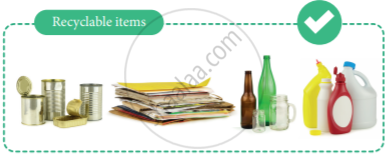
Recyclable: ______
The use of microorganism metabolism to remove pollutants such as oil spills in the water bodies is known as ____________.
Unwanted materials pollute our ______.
Garbage buried inside landfills remain here for a long time as they decompose very slowly and become _______.
Match the following:
| i. | Avoid the usage | a. | Recycle |
| ii. | Sharing newspapers | b. | Incinerate |
| iii. | Using fountain pens | c. | Buying packaged food |
| iv. | Using old clothes to make paper | d. | Reducing |
| v. | Human anatomical waste | e. | Reusing |
India produces 532 million kilos of solid waste every day.
Paheli gave the following ill effects of the practice of burning dried leaves and other plant parts
- Burning degrades the soil.
- Burning produces harmful gases/fumes.
- Precious raw materials to obtain manure at low cost is lost.
- Lot of heat is generated unnecessarily.
The correct reasons of why we should not burn leaves are
Provide a suitable term that expresses the meaning of the following statement.
Contents of the waste bins.
