Advertisements
Advertisements
Question
State four characteristics of the image formed by a plane mirror.
Advertisements
Solution
- Image formed by a plane mirror is always virtual and erect.
- The size of the image is equal to that of the object.
- The image formed is as far behind the mirror as the object is in front of it.
- The image is laterally inverted.
RELATED QUESTIONS
Suppose you are in a dark room. Can you see objects in the room? Can you see objects outside the room? Explain.
Select the correct alternative
The image formed by a plane mirror is
You are standing at a distance of 2 meters from a plane mirror.
What is the distance of your image from the mirror?
What is meant by lateral inversion of an image in a plane mirror ? Explain it with the help of a diagram.
Differentiate between the reflection of light from a plane mirror and that from a plane sheet of paper.
Draw a diagram to show the reflection of a ray of light using a plane mirror. In the diagram, label the incident ray, the reflected ray, the normal, the angle of incidence and the angle of reflection.
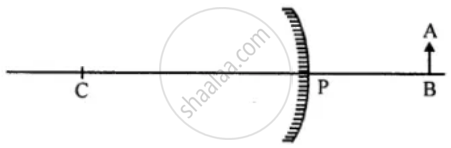
Copy the figure. By taking two rays from point A, show the formation of image. State four characteristics of the image.
State whether the following statement is true or false. If false, correct it.
The angle of incidence is the angle made by the incident ray with the plane mirror.
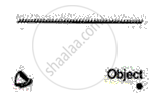
Complete the ray diagram to show the image observed by the eye after reflection in the following figure.
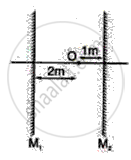
Locate the image termed when the object is placed between two planes as shown in the following figure.
Define the term Principle axis.
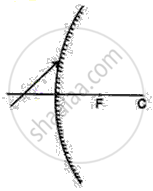
Complete the path of incident ray in the following case.
In a completely dark room, if you hold up a mirror in front of you, will you see a reflection of yourself in the mirror?
An object that blocks all of the light from passing through is ______.
Which of the following can make a parallel beam of light when light from a point source is incident on it?
Suppose we wish to obtain the real image of a distant tree. Explain two possible ways in which we can do it.
Match the following:
| 1. | Rubber | a. | Erect |
| 2. | Greased paper | b. | Inverted |
| 3. | Real image | c. | Opaque medium |
| 4. | Virtual image | d. | Translucent medium |
