Advertisements
Advertisements
प्रश्न
State four characteristics of the image formed by a plane mirror.
Advertisements
उत्तर
- Image formed by a plane mirror is always virtual and erect.
- The size of the image is equal to that of the object.
- The image formed is as far behind the mirror as the object is in front of it.
- The image is laterally inverted.
संबंधित प्रश्न
Suppose you are in a dark room. Can you see objects in the room? Can you see objects outside the room? Explain.
Write true or false of the following statement.
The image formed by a plane mirror can be obtained on a screen.
Wirte down the letter C and I as seen in a plane mirror.
The perpendicular to the mirror at the point of incidence is called ______.
State which surface of a plane mirror reflects most of the light incident on it: the front smooth surface or the back silvered surface.
Explain the following term:
Angle of incidence. Draw diagram/diagrams to show them.
An object 1.5 cm high when placed in front of a concave. the mirror produces a virtual image 3 cm high. If the object is placed at a distance of 6 cm from the pole of the mirror, calculate:
- the position of the image
- the focal length of the mirror.
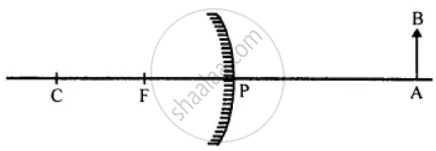
Copy the figure. By taking two rays from point A, show the formation of image. State four characteristics of the image.
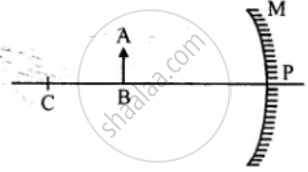
Copy the figure and complete it, by drawing two rays to show the formation of the image of the object AB. State the size, position and nature of image formed.
Out of the following, choose the substance which is translucent medium:
A boy is standing in front of a plane mirror at a distance of 3 m from it.
(i) What is the distance between the boy and his image?
(ii) If the boy moves 1 m backward, find the distance between the image and the boy.
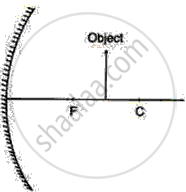
By geometrical construction, find the position of the image in the following figure.
Reflection occurs , when the light
Match the following:
| 1. | Vegetable oil | a. | Transparent |
| 2. | Glass | b. | Translucent |
| 3. | Wood | c. | Waterproof |
| 4. | Aluminum foil | d. | Opaque |
Select the WRONG statement in case of image formed by a plane mirror.
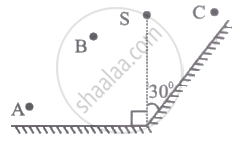
A point source of light S is placed in front of two large mirrors as shown. Which of the following observers will see only one image of S?