Advertisements
Advertisements
प्रश्न
An object 1.5 cm high when placed in front of a concave. the mirror produces a virtual image 3 cm high. If the object is placed at a distance of 6 cm from the pole of the mirror, calculate:
- the position of the image
- the focal length of the mirror.
Advertisements
उत्तर
Size of object = h0 = 1.5 cm
Size of image = h1 = + 3 cm [Image formed by a concave mirror is virtual]
Distance of the object from the pole of the mirror = u = - 6 cm
(i) Distance of the image from the pole of mirror = v = ?
Linear magnification = m = `"h"_1/"h"_0 = - "v"/"u"`
`(+3)/1.5 = - "v"/-6`
v = `+ (6 xx 3)/1.5`
v = + 12 cm
So, image is formed at a distance of 12 cm behind the concave mirror.
(ii) Focal length of the concave mirror = f = ?
Using mirror formula:
`1/"u" + 1/"v" = 1/"f"`
`1/-6 + 1/(+12) = 1/"f"`
`1/"f" = - 1/6 + 1/12 = (- 2 +1)/12 = -1/12`
⇒ f = - 12 cm
APPEARS IN
संबंधित प्रश्न
If the angle between the plane mirror and the incident ray is 40∘, what are the angles of incidence and reflection?
Draw a diagram to show the reflection of a ray of light using a plane mirror. In the diagram, label the incident ray, the reflected ray, the normal, the angle of incidence and the angle of reflection.
Describe the principle of simple periscope through an outline ray diagram. Give one of its uses.
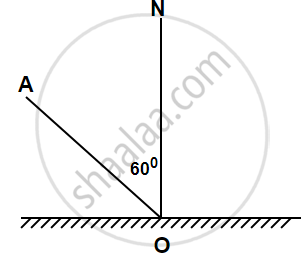
Show an incident ray AO and the normal ON a plan mirror. draw the reflected ray and then find the angle between the incident and reflected rays.
The light ray gets _______ when it falls on any polished surface.
Beams of light are incident through the holes A and B and emerge out of box through the holes C and D respectively as shown in the Figure Which of the following could be inside the box?

Select the WRONG statement in case of image formed by a plane mirror.
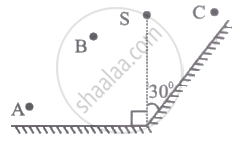
A point source of light S is placed in front of two large mirrors as shown. Which of the following observers will see only one image of S?