Advertisements
Advertisements
प्रश्न
An object 1.5 cm high when placed in front of a concave. the mirror produces a virtual image 3 cm high. If the object is placed at a distance of 6 cm from the pole of the mirror, calculate:
- the position of the image
- the focal length of the mirror.
Advertisements
उत्तर
Size of object = h0 = 1.5 cm
Size of image = h1 = + 3 cm [Image formed by a concave mirror is virtual]
Distance of the object from the pole of the mirror = u = - 6 cm
(i) Distance of the image from the pole of mirror = v = ?
Linear magnification = m = `"h"_1/"h"_0 = - "v"/"u"`
`(+3)/1.5 = - "v"/-6`
v = `+ (6 xx 3)/1.5`
v = + 12 cm
So, image is formed at a distance of 12 cm behind the concave mirror.
(ii) Focal length of the concave mirror = f = ?
Using mirror formula:
`1/"u" + 1/"v" = 1/"f"`
`1/-6 + 1/(+12) = 1/"f"`
`1/"f" = - 1/6 + 1/12 = (- 2 +1)/12 = -1/12`
⇒ f = - 12 cm
APPEARS IN
संबंधित प्रश्न
You are standing at a distance of 2 meters from a plane mirror.
What is the distance of your image from the mirror?
What do you mean by reflection of light?
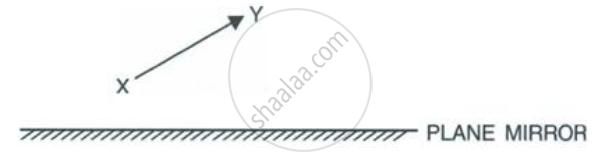
The diagram below in figure shows an object XY in front of a plane mirror MM1 . Draw on the diagram, path of two rays from each point X and Y of the object to show the formation of its image .
Describe the principle of simple periscope through an outline ray diagram. Give one of its uses.
Compare the characteristics of an image formed by a convex mirror and a concave mirror, when object is beyond center of curvature, but not at infinity.
Find the odd one.
sun, candle, torch, pen
Beams of light are incident through the holes A and B and emerge out of box through the holes C and D respectively as shown in the Figure Which of the following could be inside the box?

