Advertisements
Advertisements
प्रश्न
An object 3 cm high produces a real image 4.5 cm high when placed at a distance of 20 cm from a concave mirror. Calculate:
- the position of image
- focal length of the concave mirror.
Advertisements
उत्तर
Size of object = ho = 3 cm
Size of image = h1 = -4.5 cm [Image formed is real]
Distance of the object from the concave mirror = u = – 20 cm
Distance of the image from the concave mirror = v = ?
Focal length of the concave mirror = f = ?
Linear magnification = m = `"h"_1/"h"_0 = - "v"/"u"`
`(- 4.5)/3 = "v"/-20`
v = `(- 20 xx 4.5)/3 = - 30` cm
Now, using mirror formula:
`1/"u" + 1/"v" = 1/"f"`
`1/-20 + 1/-30 = 1/"f"`
`1/"f" = - 1/20 - 1/30`
`1/"f" = (- 3 - 2)/60 = - 5/60 = - 1/12`
⇒ f = - 12 cm
APPEARS IN
संबंधित प्रश्न
Write true or false of the following statement.
The image formed by a plane mirror is real
Fill in the blank
A plane mirror _________ reflects 100 percent light falling on it.
The following diagram shows a point object O placed in front of a plane mirror. Take two rays from the point O and show how the image of O is formed and seen by the eye.

How is the position of image formed by a plane mirror related to the position of the object ?
State two uses of a plane mirror.
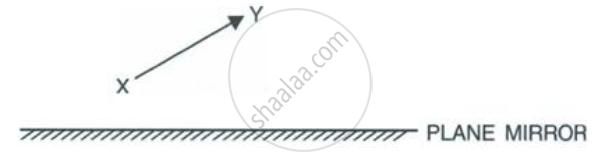
The diagram below in figure shows an object XY in front of a plane mirror MM1 . Draw on the diagram, path of two rays from each point X and Y of the object to show the formation of its image .
Materials which reflect the light well are called ______.
Beams of light are incident through the holes A and B and emerge out of box through the holes C and D respectively as shown in the Figure Which of the following could be inside the box?

Play with a mirror
Write your name with a sketch pen on a thin sheet of paper, polythene or glass. Read your name on the sheet while standing in front of a plane mirror. Now look at your image in the mirror.
