Advertisements
Advertisements
Question
An object 3 cm high produces a real image 4.5 cm high when placed at a distance of 20 cm from a concave mirror. Calculate:
- the position of image
- focal length of the concave mirror.
Advertisements
Solution
Size of object = ho = 3 cm
Size of image = h1 = -4.5 cm [Image formed is real]
Distance of the object from the concave mirror = u = – 20 cm
Distance of the image from the concave mirror = v = ?
Focal length of the concave mirror = f = ?
Linear magnification = m = `"h"_1/"h"_0 = - "v"/"u"`
`(- 4.5)/3 = "v"/-20`
v = `(- 20 xx 4.5)/3 = - 30` cm
Now, using mirror formula:
`1/"u" + 1/"v" = 1/"f"`
`1/-20 + 1/-30 = 1/"f"`
`1/"f" = - 1/20 - 1/30`
`1/"f" = (- 3 - 2)/60 = - 5/60 = - 1/12`
⇒ f = - 12 cm
APPEARS IN
RELATED QUESTIONS
Write true or false of the following statement.
The image formed by a plane mirror is real
The reflection of light from a wooden surface is _________ reflection.
A light ray is incident normally on a plane mirror. (a) What is its angle of incidence?
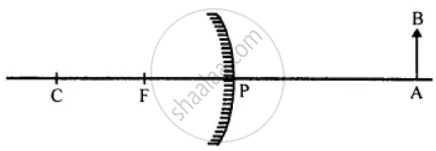
Copy the figure and complete it, by drawing two rays to show the formation of the image of the object AB. State the size, position and nature of image formed.
The angle between an incident ray and the mirror is 350.
(i) What is the angle of incidence?
(ii) What is the angle of reflection?
(iii) What is the total angle turned by the ray of light?
(iv) What is the angle between the incident and the reflected rays?
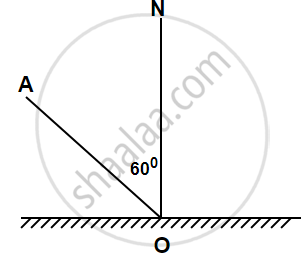
Show an incident ray AO and the normal ON a plan mirror. draw the reflected ray and then find the angle between the incident and reflected rays.
Define the term Principle axis.
______ through which light can pass completely.
Figure shows a ray of light as it travels from medium A to medium B. Refractive index of the medium B relative to medium A is

