Advertisements
Advertisements
Question
Which of the following can make a parallel beam of light when light from a point source is incident on it?
Options
Concave mirror as well as convex lens
Convex mirror as well as concave lens
Two plane mirrors placed at 90° to each other
Concave mirror as well as concave lens
Advertisements
Solution
Concave mirror as well as convex lens
Explanation -
When the point source is kept at the focus of the concave mirror and convex lens, the light rays after reflection and refraction respectively, will become parallel to the principal axis.
APPEARS IN
RELATED QUESTIONS
Select the correct alternative
The image formed by a plane mirror is
The following diagram shows a point object O placed in front of a plane mirror. Take two rays from the point O and show how the image of O is formed and seen by the eye.

State two uses of a plane mirror.
State two advantages and two disadvantages of the reflecting periscope.
A converging mirror, forms three times magnified virtual image when an object is placed at a distance of 8 cm from it. Calculate:
- the position of the image
- the focal length of the mirror.
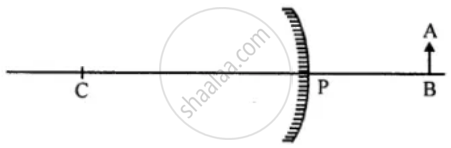
Copy the figure. By taking two rays from point A, show the formation of image. State four characteristics of the image.
You are provided a convex mirror, a concave mirror and a plane mirror. How will you distinguish between them, without touching or using any other apparatus?
Identify the following kind of beam of light.
Draw two sets of rays of light to show the formation of an image of the letter as shown in figure p.

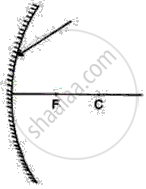
Complete the path of incident ray in the following case.
Find the odd one.
sun, candle, torch, pen
Say TRUE or FALSE
We see planets because they reflect light from the sun
What is reflection of light?
State the direction of incident ray which after reflection from a spherical mirror retraces its path. Give reason for your answer.
Higher Order Thinking Skills.
When a ray of light passes from air into glass, is the angle of refraction greater than or less than the angle of incidence?
What kind of surface reflects light?
