Advertisements
Advertisements
प्रश्न
Which of the following can make a parallel beam of light when light from a point source is incident on it?
पर्याय
Concave mirror as well as convex lens
Convex mirror as well as concave lens
Two plane mirrors placed at 90° to each other
Concave mirror as well as concave lens
Advertisements
उत्तर
Concave mirror as well as convex lens
Explanation -
When the point source is kept at the focus of the concave mirror and convex lens, the light rays after reflection and refraction respectively, will become parallel to the principal axis.
APPEARS IN
संबंधित प्रश्न
Suppose you are in a dark room. Can you see objects in the room? Can you see objects outside the room? Explain.
David is observing his image in a plane mirror. The distance between the mirror and his image is 4 m. If he moves 1 m towards the mirror, then the distance between David and his image will be ______.
Write true or false of the following statement.
The image of the right hand in a plane mirror looks like that of a left hand.
Write true or false of the following statement.
The image formed by a plane mirror can be obtained on a screen.
Fill in the blank
The image formed by a plane mirror is at a distance behind the mirror as ________
State four characteristics of the image formed by a plane mirror.
How is the position of image formed by a plane mirror related to the position of the object ?
Explain the following term:
Angle of reflection. Draw diagram/diagrams to show them.
With the help of diagrams, explain the difference between the regular and irregular reflection.
A light ray is incident normally on a plane mirror. (a) What is its angle of incidence?
Give two uses of concave mirror.
The reflection of a ray of light (OA) normally incident on a plane mirror is shown below
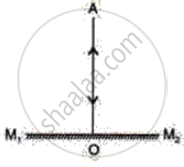
What are the angles of incidence and reflection?
State whether the following statement is true or false. If false, correct it.
If a ray of light incident on a plane mirror is such that it makes an angle of 30o with the mirror, then the angle of reflection is 60o.
The light ray gets _______ when it falls on any polished surface.
Say TRUE or FALSE
We see planets because they reflect light from the sun
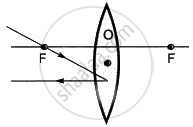
Which of the following ray diagrams is correct for the ray of light incident on a lens shown in figure?

 |
 |
| A | B |
 |
 |
| C | D |
______ through which light can pass partially.
The image formed by a plane mirror is always as far behind the mirror as far the object lies in front of it.
