Advertisements
Advertisements
Question
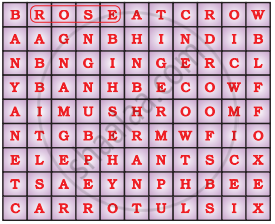
Spot as many organisms as possible in the puzzle given as Figure by encircling them as shown. Write the names on a sheet of paper and categorise them into autotrophs and heterotrophs. Classify the heterotrophs into herbivores, carnivores, omnivores and saprophytes.
Advertisements
Solution
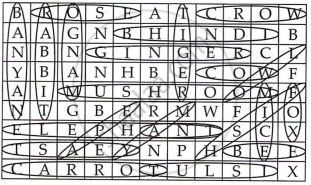
Autotrophs: rose, mango, bhindi, carrot, banyan, tulsi, ginger, yam
Heterotrophs: elephant, ant, yeast, tiger, mushroom, fox, mice, owl, cow, crow, rabbit, bee, fish, ape
Herbivores: elephant, cow, rabbit, bee
Carnivores: tiger
Omnivores: ant, mice, owl, crow, fox, ape
Saprophytes: mushroom, yeast
Notes
Fish can be herbivores, carnivores or omnivores depending on the species.
APPEARS IN
RELATED QUESTIONS
The food synthesised by the plants is stored as ______.
Arrange the following processes involved in the nutrition in animals in the correct order (in which they take place):
Assimilation, Egestion, Ingestion, Absorption, Digestion
What substances enter into the food vacuole in Amoeba to break down the food?
All non-green plants and animals are ______.
What are herbivores?
Classify the following into herbivores, carnivores and omnivores:
Lion, Man, Dog, Goat, Crow, Elephant, Snake, Hawk, Rabbit, Deer
| X is a wild animal which eats only the flesh of other animals whereas Y is a domestic animal which feeds mainly on green grass. |
- What are animals like X known as?
- What are animals Y known as?
- Which animal, X or Y, has a longer small intestine? Why?
- Name one animal which is like X.
- Name one animal which is like Y.
In the expriment of preparing a temporary mount of a leaf peel to observe stomata, we use two liquids other than water. Name these two liquids and state when and why these liquids are used.
Select the correct statement
Patients whose gallbladder are removed are recommended to eat less oily food. Why?
