Advertisements
Advertisements
प्रश्न
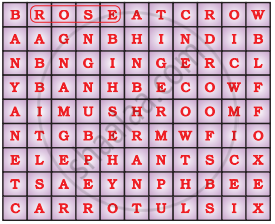
Spot as many organisms as possible in the puzzle given as Figure by encircling them as shown. Write the names on a sheet of paper and categorise them into autotrophs and heterotrophs. Classify the heterotrophs into herbivores, carnivores, omnivores and saprophytes.
Advertisements
उत्तर
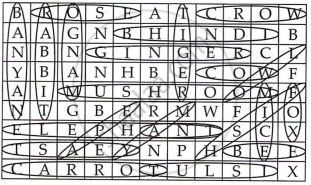
Autotrophs: rose, mango, bhindi, carrot, banyan, tulsi, ginger, yam
Heterotrophs: elephant, ant, yeast, tiger, mushroom, fox, mice, owl, cow, crow, rabbit, bee, fish, ape
Herbivores: elephant, cow, rabbit, bee
Carnivores: tiger
Omnivores: ant, mice, owl, crow, fox, ape
Saprophytes: mushroom, yeast
Notes
Fish can be herbivores, carnivores or omnivores depending on the species.
APPEARS IN
संबंधित प्रश्न
The food synthesised by the plants is stored as ______.
Name an animal whose process of obtaining food is called phagocytosis.
All the animals can be divided into three groups on the basis of their eating habits. Name the three groups.
Arrange the following processes involved in the nutrition in animals in the correct order (in which they take place):
Assimilation, Egestion, Ingestion, Absorption, Digestion
From which part of the body, undigested food is egested in Amoeba?
Name a unicellular animal which uses cilia to move food particles into it mouth.
All non-green plants and animals are ______.
Heterotrophs depend on ______ and other ______ for food.
Name the five steps which occur in the process of nutrition in animals.
Which of the following is the correct statement?
