Advertisements
Advertisements
प्रश्न
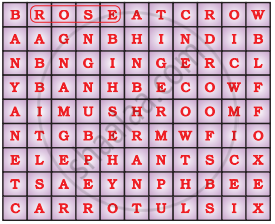
Spot as many organisms as possible in the puzzle given as Figure by encircling them as shown. Write the names on a sheet of paper and categorise them into autotrophs and heterotrophs. Classify the heterotrophs into herbivores, carnivores, omnivores and saprophytes.
Advertisements
उत्तर
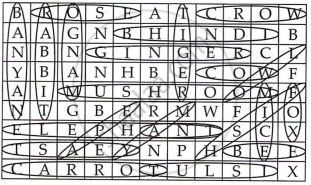
Autotrophs: rose, mango, bhindi, carrot, banyan, tulsi, ginger, yam
Heterotrophs: elephant, ant, yeast, tiger, mushroom, fox, mice, owl, cow, crow, rabbit, bee, fish, ape
Herbivores: elephant, cow, rabbit, bee
Carnivores: tiger
Omnivores: ant, mice, owl, crow, fox, ape
Saprophytes: mushroom, yeast
Notes
Fish can be herbivores, carnivores or omnivores depending on the species.
APPEARS IN
संबंधित प्रश्न
The food synthesised by the plants is stored as ______.
Arrange the following processes involved in the nutrition in animals in the correct order (in which they take place):
Assimilation, Egestion, Ingestion, Absorption, Digestion
What substances enter into the food vacuole in Amoeba to break down the food?
Heterotrophs depend on ______ and other ______ for food.
Give one example of a heterotroph.
Which of the following is the correct statement?
| X is a wild animal which eats only the flesh of other animals whereas Y is a domestic animal which feeds mainly on green grass. |
- What are animals like X known as?
- What are animals Y known as?
- Which animal, X or Y, has a longer small intestine? Why?
- Name one animal which is like X.
- Name one animal which is like Y.
List four precautions in proper sequence which we observe while preparing a temporary mount of a leaf peel.
In which mode of nutrition an organism derives its food from the body of another living organism without killing it?
The mode of nutrition found in fungi is:
