Advertisements
Advertisements
Question
Short answer question.
Describe valves of human heart.
Advertisements
Solution
Both the atria open into ventricles of their respective sides by atrioventricular apertures. The atrio-ventricular apertures are guarded by cuspid valves.
i. Cuspid valves:
These are bicuspid and tricuspid valves. The bicuspid valve also known as the mitral valve is present in the left atrio-ventricular aperture. Tricuspid valve is present in the right AV aperture.
ii. Eustachian valve:
It is present on the opening of the post-caval vein (inferior vena cava).
iii. Thebesian valve:
It guards the opening of the coronary sinus into the right atrium.
iv. Semilunar valves:
These three valves guard the opening between the right ventricle and pulmonary artery and left ventricle and aorta.
APPEARS IN
RELATED QUESTIONS
Foetus : Amnion : : Heart: ______
Name the following:
The first heart sound.
Describe in brief die cardiac cycle.
The diagram given below represents the human heart in one phase of its activity. Study the same and then answer the questions that follow:
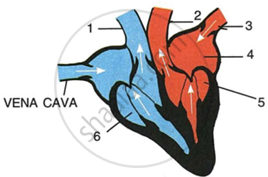 |
- Name the phase.
- Which part of the heart is contracting in this phase? Give a reason to support your answer.
- Name the parts numbered 1to6.
- What type of blood flows through the parts marked 'l' and '2' respectively?
- How many valves are closed in this phase?
Name an instrument which is used to hear heart sounds.
Column 2 is a list of items related to ideas in Column 1. Match the term in Column 2 with the suitable idea given in Column 1.
| Column 1 | Column 2 |
| (i) Superior vena cava | (a) Collect deoxygenated blood from the wall of the heart. |
| (ii) Inferior vena cava | (b) Carry oxygenated blood to heart muscle. |
| (iii) Pulmonary vein | (c) Collects deoxygenated blood from upper part. |
| (iv) Coronary veins | (d) Collects deoxygenated blood from lower parts. |
| (v) Coronary artery | (e) Brings oxygenated blood from lungs. |
| (vi) Aorta | (f) Large artery |
| (vii) Heart attack | (g) Large vein |
| (viii) Blood Pressure | (h) Oxygenated blood |
| (ix) Tricuspid valve | (i) Sphygmomanometer |
| (x) Bicuspid valve | (j) Allows blood flow from right auricle to right ventricle. |
| (xi) Contraction and relaxation of heart | (k) Blocking of coronary arteries. |
| (l) Cardiac muscle. | |
| (m) Allows blood flow from left auricle to left ventricle. | |
| (n) Allows blood flow from right ventricle of pulmonary aorta. |
What is the function of pericardial fluid?
Name the heart valve associated with the major arteries leaving the ventricles.
Identify the CORRECT statement with respect to serous pericardium.
Explain the structure of heart.
