Advertisements
Advertisements
Question
Shan is utilising a dynamometer to measure the force, expressed in newtons, on a bowstring. He records both the force and displacement of the bowstring and plots the data on a graph that shows the relationship between force in newtons and displacement in centimetres. Shan is interested in determining the highest point that the arrow reaches. He knows he can calculate the work done by finding the area under the graph.
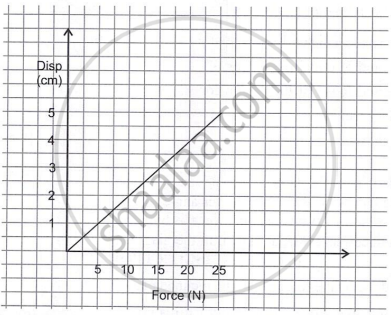
- What is the potential energy stored in the bow string, when the force is 25 N?
- If the mass of the arrow is 31.25 g, calculate the maximum velocity attained by the arrow.
- Calculate the maximum height reached by the arrow.
Advertisements
Solution
(a) Given: Maximum Force = 25 N
Displacement = 20 cm = 0.20 m
The work done (stored potential energy) is equal to the area under the triangular force–displacement graph.
\[ \text{Potential Energy (P.E.)} = \frac{1}{2} \times \text{Base (Displacement)} \times \text{Height (Force)} \]
\[ \text{P.E.} = \frac{1}{2} \times 0.20\ \mathrm{m} \times 25\ \mathrm{N} \]
P.E. = 2.5 J
(b) Given: Mass of the arrow (m) = 31.25 g = 0.03125 kg
When released, the stored potential energy converts entirely into the kinetic energy (K.E.) of the arrow.
\[ \frac{1}{2}\, mv^{2} = \text{Stored P.E.} \]
\[ \frac{1}{2} \times 0.03125 \times v^{2} = 2.5 \]
\[ v^{2} = \frac{2 \times 2.5}{0.03125} \]
v2 = 160
\[ v = \sqrt{160} \]
≈ 12.65 m/s (or 12.6 m/s)
(c) Given: Acceleration due to gravity (g) = 10 m/s2
At the highest point, the kinetic energy converts completely into gravitational potential energy (mgh).
m · g · h = 2.5 J
0.03125 × 10 × h = 2.5
0.3125 × h = 2.5
\[ h = \frac{2.5}{0.3125} \]
h = 8 m
