Advertisements
Advertisements
Question
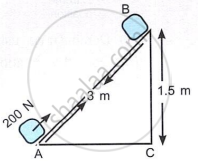
A block of mass 30 kg is pulled up a slope (diagram alongside) with a constant speed by applying a force of 200 N parallel to the slope. A and B are the initial and final positions of the block. Calculate the force of friction offered by the surface AB.
Numerical
Advertisements
Solution
The block moves at constant speed, so the net force along the slope is zero.
From the diagram, \[ \sin\theta = \frac{\text{height}}{\text{slope length}} \]
\[= \frac{1.5}{3} \]
= 0.5
The component of the block’s weight acting down the slope = mg sin θ
= 30 × 10 × 0.5
= 150 N
The applied force is 200 N up the slope.
Therefore, friction acts down the slope and balances the remaining force.
Friction = 200 − 150 = 50 N
The force of friction is 50 N, acting down the slope.
shaalaa.com
Is there an error in this question or solution?
