Advertisements
Advertisements
Question
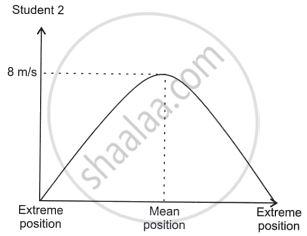
Two students are conducting experiments with identical 100 g mass simple pendulums, each raising the bob 5 m above the mean position. The graph depicting the relationship between distance from the mean position and velocities is presented in the diagram.
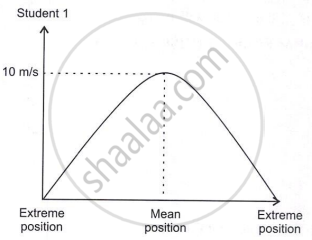
- Demonstrate, using mathematical calculations, that the path followed by student 1 is devoid of friction.
- Does the situation involving student 2 exhibit a breach of the law of conservation of energy?
Advertisements
Solution
Given Data: Mass of each bob (m) = 100 g = 0.1 kg
Initial height above mean position (h) = 5 m
Acceleration due to gravity (g) = 10 m/s2
(a) For Student 1:
1. Initial Potential Energy at Extreme Position:
P.E. = m · g · h
= 0.1 × 10 × 5
= 5 J
2. Maximum Kinetic Energy at Mean Position (v = 10 m/s):
\[ \text{K.E.} = \frac{1}{2}\, mv^{2} \]
\[= \frac{1}{2} \times 0.1 \times (10)^{2} \]
= 5 J
Since Initial P.E. (5 J) = Maximum K.E. (5 J), no mechanical energy is lost. Hence, the path is devoid of friction.
(b) For Student 2:
1. Maximum Kinetic Energy at Mean Position (v = 8 m/s):
\[ \text{K.E.} = \frac{1}{2}\, mv^{2} \]
\[= \frac{1}{2} \times 0.1 \times (8)^{2} \]
= 3.2 J
2. Energy Loss = 5 J − 3.2 J
= 1.8 J
No, it does not breach the law. The missing 1.8 J of energy is simply transformed into heat and sound energy due to air resistance. Since total energy remains constant, the law of conservation of energy is perfectly obeyed.
