Advertisements
Advertisements
Question
Read the case given below and answer the questions that follow:
| Rohit owned a restaurant in a small city. During the pandemic 2020, his restaurant remained closed which incurred heavy financial losses for him. The prolonged lockdown also affected his mental state and caused him profound sadness. He isolated himself from his family and friends. |
- Identify the psychological disorder in Rohit.
- Briefly explain any two causes of this psychological disorder.
- Elaborate on any four symptoms of this psychological disorder.
Advertisements
Solution
- Major Depressive Disorder, also known as Clinical Depression, is the recognized psychological condition affecting Rohit.
- There could be two reasons for this psychological disorder: the long isolation that affected his mental health and the financial loss brought on by the restaurant's ending.
- The four signs of major depression include:
- depression for most of the day, almost every day;
- loss of interest or delight in practically all activities;
- severe daily fluctuations in hunger, either a decrease or a rise in weight, and
- Almost daily, either hypersomnia or lack of sleep. Major depressive disorder cannot be diagnosed without the presence of at least five symptoms, which include a gloomy mood or a lack of interest or enjoyment in almost all activities, according to the DSM-5. In addition, the symptoms must significantly impact social, vocational, or other crucial domains of functioning or cause significant discomfort.
APPEARS IN
RELATED QUESTIONS
Answer the following question briefly:
State two characteristics of Generalized Anxiety Disorder.
What is obsessive-compulsive disorder?
Answer the following question briefly:
What is meant by the term projection?
Give any two causes of severe depression.
Give any two causes of Obsessive-Compulsive Disorder.
A psychological disorder that is characterised by free-floating anxiety is called ______.
Sumit, aged seven years, is often scolded by his teachers as he distracts his classmates. The teachers have to make extra efforts to make him sit in class and pay attention. He disrupts the class by walking around.
- Identify the type of disorder displayed by Sumit.
- Explain any three symptoms of the disorder identified in subpart (a).
Observe the image given below and answer the question that follow.
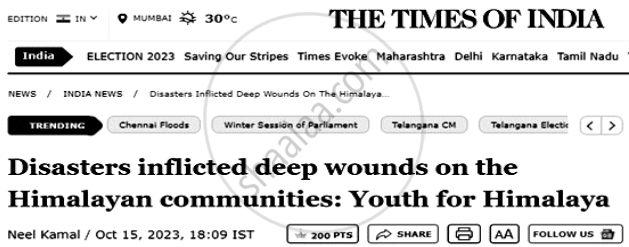
Predict any two possible psychological impact that natural disasters can have on the Himalayan community.
Observe the image given below and answer the question that follow.
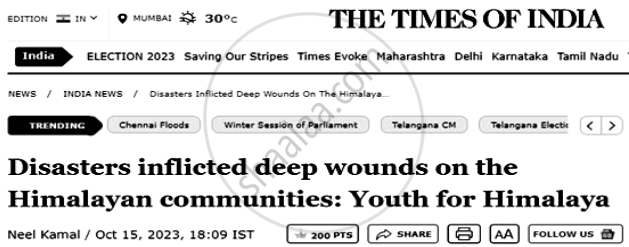
Enumerate any five ways to promote pro-environmental behaviour among people.
Read the passage given below and answer the questions that follow.
|
Fifteen candidates applied for the position of Executive Manager in a private company. The candidates were called individually for a conversation in the first round of recruitment. In the second round, they were given a list of statements on personality factors that they had to rate a scale value for. The final round consisted of a group task in which the candidates were divided into three groups. Each group had to overcome a problem situation given to them. |
- Describe the types of behavioural analysis that were conducted on the candidates in the first and second rounds. (4)
- In your opinion, which type of behavioural analysis would help the directors select the suitable candidate? Justify your answer by giving two reasons. (3)
