Advertisements
Advertisements
Question
B1. Choose
Choose the correct alternatives and complete the sentences (2)
(1) The narrator is :
(a) an astronaut
(b) an engineer studying in BITS Pilani
(c) in the team of astronauts.
(2) Armstrong said, 'That's one small step for a man, one giant leap for mankind which means:
(a) one step on the moon means, many steps on the earth.
(b) he felt like a giant on the moon.
(c) one moon mission had opened up many avenues in science and technology for mankind.
It was late evening of July 20. 1969, when we turned up the hostel radio. I was an engineering student at BITS, Pilani. I still remember the feverish excitement that gripped us from July 16 when Apollo 11. the US space rocket, took off from Cape Kennedy, Florida. Neil Armstrong and his team of astronauts, Edwin "Buzz" Aldrin and Michael Collins, were to land on moon, for the first time in human history. We listened 'with rapt attention when Armstrong declared: "That's one small step for a man, one giant leap for mankind."
His death on Saturday, August 25, is a moment to salute the romance of space science that Apollo 11 unleashed. It has changed forever the way we look at our planet Earth and its satellite, the moon.
Standing on powdery moondust, Armstrong put up his thumb, shut one eye and found his thumb blotting out the Earth. "It suddenly struck me that that tiny pea, pretty and blue, was the Earth” he said later. "I felt very, very small." But behind that humbling realisation stood a giant truth:
The effort to explore the universe united mankind in technology and knowledge. Each moon mission, about 110 till date, provided more confidence to take on bolder projects.
B2. Complete (2)
(1) Armstrong describes the earth as ……………
(2) The effort to explore the universe has ………………
(3) Apollo 11 unleashed and changed forever ………………
(4) The author came to know about Apollo 11 mission when he …………..
B3. Solve
Solve the crossword with the clues given below. Refer to the passage for your answers: (2)

Down : (1) The area beyond the earth's atmosphere .
(2) The name of the spacecraft that Armstrong travelled.
Across : (3) A person trained to travel in space.
(4) Y A natural satellite of the earth.
B4. Begin the sentence
(i) With-For the first time .......and rewrite [1]
Neil Armstrong, Edwin Aldrin and Michael Collins were, to land on the moon for the first time.
(ii) Insert 'that' appropriately and rewrite. [1]
Armstrong found his thumb blotting out the Earth.
B5. Personal Response
Would you like to be an astronaut? Give reasons.
Advertisements
Solution
B1. Choose:
(1) The narrator is an engineer studying in BITS Pilani.
(2) Armstrong said, “That’s one small step for a man, one giant leap for mankind which means
one moon mission had opened up many avenues is science and technology for mankind.
B2. Complete:
(1) Armstrong describes the earth as a tiny pea, pretty and blue.
(2) The effort to explore the universe has united mankind in technology and knowledge.
(3) Apollo 11 unleashed the romance of space science and changed forever the way we look at our
planet Earth and its satellite, the moon.
(4) The author came to know about Apollo 11 mission when he heard about it on the radio on July
20, 1969.
B3. Solve:
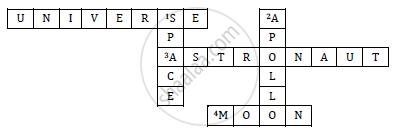
B4.
(i) For the first time, Neil Armstrong, Edwin Aldrin and Michael Collins were to land on the moon.
(ii) Armstrong found that his thumb was blotting out the Earth.
B5.
Yes, I would love to be an astronaut. Astronauts get the opportunity to travel to space. They collect
data and specimens needed for research work which is conducted for the benefit of the whole world.
APPEARS IN
RELATED QUESTIONS
Read the extract given below and answer the questions that follow :
When I got to New Mullion, my eager expectations of a sweet and simple country village were severely disappointed. Its streets were rivers of mud, with rows of wooden shops, either painted a sour brown, or bare of any paint at all.
(a) Who is 'I'?
(b) Why was 'I' disappointed?
(c) What does the word 'expectations' mean ?
Read the passage given below and answer the questions that follow:
1. Thackeray reached Kittur along with a small British army force and a few of his officers. He thought that the very presence of the British on the outskirts of Kittur would terrorise the rulers and people of Kittur and that they would lay down their arms. He was quite confident that he would be able to crush the revolt in no time. He ordered that tents be erected on the eastern side for the fighting forces and a little away on the western slopes tents be put up for the family members of the officers who had accompanied them. During the afternoon and evening of 20thOctober, the British soldiers were busy making arrangements for these camps.
On the basis of your understanding of the above passage complete the statements given below with the help of options that follow:
(ii) army officer
(iii) adviser to Rani of Kittur
(iv) treasury officer
(ii) enjoy life in tents
(iii) stay in the palace
(iv) give company to officers
(c) Why did Thackeray come to Kittur?
(d) Why did the Kittur officials refuse to give the desired assurance to Thackeray?
(e) What happened to the Horse Artillery?
(f) How do we know that the Rani was a noble queen?
(g) How in your opinion would the British women have felt after meeting the Rani?
(h) Why did the Rani refuse to meet Thackeray?
(i) Find words from the passage which mean the same as the following :
ii. aggressive/refusing to obey (para 2)
Read the following extract and answer the questions given
below:
Prominent among the urges that inspire and drive a person in life, is the mge to be a somebody. It is quite human, especially in the early stages of life, to want to do something to win laurels and admiration of all around. There's a pitfall though - the very process of becoming a somebody may subtly reduce yon to a nobody.
American poet Emily Dickinson, who lived in obscurity, has an interesting poem on this theme. "I'm nobody!" she declares, with apparent pride.
"Who are you?
Are you nobody, too?"
Why should anybody be happy about being nobody?
The poem explains :
"How dreaiy to he somebody!
How public, like a frog
To tell your name the livelong day
To an admiring bog!
The word 'bog' is significant. When you become a somebody, you invite adulation :
this then begins to bog you down. The moment you think you have arrived, you begin to stagnate, or, worse, your downslide begins. An endless list of writers, artists, sportsmen, politicians ..... fit this pattern of personal history.
To sustain your development in absolute terms, to become a true somebody, it is important to remain a temporal nobody. Even if destiny makes you a temporal somebody,
you should be able to see yourself as merely an agent of a superior power; no more. This requires an exercise of will. You have to constantly watch out and talk to yourself morning and evening.
(1) What is the main idea of the extract? (1)
(2) Why is it important for one to remain a temporal nobody? How? (1)
(3) What does Emily Dickinson declare with pride? Why? (2)
(4) What would you like to be in your life - Somebody or nobody? Why? (2)
(5) Rewrite the following sentences in the ways instructed
(i) This requires an exercise of will.
(Rewrite it using the Simple Future tense.) (1)
(ii) You have to constantly watch out and talk to yourself.
(Rewrite it using another modal auxiliary showing 'compulsion'.) (1)
(iii) You begin to stagnate.
(Rewrite it using the noun form of the word underlined.) (1)
(6) Find out the words from the extract which mean -
(i) danger (1/2)
(ii) praise (1/2)
(A) Read the following extract and answer the questions given below:
Chronic floods during the monsoon, on average, affect more than 30 million Indians annually Ironically, 60% of India's farmland, 66% of its livestock and its entire forest area depend on rains for survival.
According to a recently released Central Water Commission (CWC) report, on an average, 7·21 million hectares (roughly 72,000 sq. km.) go under floodwater. This water typically ravages 3·78 million hectares of agricultural land, damaging crops worth Rs. 1, 118 crores annually.
Heavy rains and floods account for nearly 1,700 lives lost annually. Apart from this, I ·25 lakh houses are annually damaged by torrential rains that also wipe out nearly 96,000 livestock.
Floods are the most recurrent natural calamity, hitting India almost every year. According to the CWC's report on financial aspects of flood control, anti-sea erosion and drainage projects, it is not possible to provide absolute protection instantly to all flood-prone areas. It says that such an attempt will neither be practical nor economically viable.
The CWC's analysis of floods in India from 1953 to 2011 shows a marginal decline in flood-affected areas over the years, the data shows 1977 1978 and 1979 were the worst-hit. The 1977 floods killed over 11,000 people, six-time the average for the 59 years, between 1953 and 2011. In terms of area and population affected, the floods of 1978 were the most destructive.
In terms off the financial loss, recent floods have been far more destructive. The total loss of crops, houses and public utilities in 2009 was Rs. 32541 crores, the highest for any year.
Question
(1) What is the above extract about?
(2) How do floods adversely affect India?
(3) Why is it not possible to provide absolute protection to all flood-prone areas?
(4) How would you help the flood-affected people?
(5) Rewrite the following sentences in the ways instructed :
(i) The floods of 1978 were the most destructive.
(Change the sentence into the 'positive degree'.)
(ii) Floods are the most recurrent natural calamity hitting India almost every year.
(Make it a complex sentence.)
(iii) Floods have been far more destructive.
(Rewrite the sentence using the Simple Present tense.)
(6) Give the meanings of:
(i) entire
(ii) calamity
(B) Write a brief summary of the above extract with the help of the points given below and suggest a suitable title.
Floods - natural, recurrent calamity in India - destroy life and property - no absolute protection - neither practical nor economically viable- floods in 1977 and 1978.
On this historic moment, I stand here to thank Pandit Jawaharlal Nehru. India’s present epoch maker has come over here to bless the state of Maharashtra which is definitely going to last forever. On behalf of thousands of common people, I express my deep sense of gratitude to him for blessing us. We Maharashtrians love him, worship him. And once again, I wish to declare that this state of Maharashtra, recently formed, will work for the betterment of the common people of Maharashtra, but if it comes to sacrifice, whatever best and grand we have, it will be done primarily for India. This is so, because, we believe from the beginning, that Maharashtra depends on India; its greatness depends on the greatness of India. All Maharashtrians believe that both India and Maharashtra can progress only when there is oneness of interest. And, therefore, I have made this clear by bringing to your notice the significance of certain symbols, for example, the Himalayas stand for lndia and the Sahyadri, for Maharashtra. The snowy Himalayas with the highest mountain ranges symbolise India and the Sahyadri with the blackest rock structure and with 200-300 inches rainfall symbolise Maharashtra. I promise you that if the Himalayas are in jeopardy, the Sahyadri of Maharashtra will use its black rock structure like a shield to protect the Himalayas.
‘Hard labour’ is the watch word of our times. And, Panditji, you have given us the message of building Maharashtra and our nation by hard labour. We are going to inscribe this valuable message on our minds and try our best to look at your blessings and your guidance, as the blessings and guidance of an epoch maker.
A1 . Read the following statements. Find out the correct statements and write them down : (2)
(i) Both India and Maharashtra can progress if they have different interests.
(ii) Hard work is the only way to build the future of India and Maharashtra.
(iii) The sacrifice of the best and grand in Maharashtra will be made for the state of Maharashtra.
(iv) In times of great calamity the Sahyadri will protect the Himalayas, like a shield.
A2. Complete the following statements : (2)
(i) The interest of Maharashtra and that of India should be one for the progress of Maharashtra state, because ................
(ii) Maharashtra depends on India, because ................
A3.Complete the table : (2)
| The name of the mountain | Stands for | The reason |
| The Himalayas The Sahyadri |
A4. Vocabulary - (2)
Give antonyms of the following words by adding prefixes :
(i) gratitude
(ii) clear
(iii) believe
(iv) significance
A5. Personal response - (2)
Give your suggestions that will help the people to make Maharashtra prosperous.
A6. Grammar - (2)
Rewrite the following sentences in the ways instructed :
(i) India and Maharashtra can progress only when there is oneness of interest.
(Rewrite it using ‘unless’)
(ii) This state of Maharashtra will work for the betterment of the common people of Maharashtra.
(Rewrite it using modal auxiliary showing ‘obligation’)
Read the following extract and answer the questions given
below:
Another relative has no plans of joining this league though.
She is rather μnabashed about waking up past noon on a daily basis. To be fair, her husband is a media personality who typically arrives home from work past midnight. That does indeed give them sufficient justification to stay longer in slumber-land each morning. This practice does lead to certain oddities though. He goes for his 'morning' walk at 1 pm, heatwaves and appalled onlookers notwithstanding. They once returned from a night out only to meet the neighbour's son who was off on an early morning jog!
Early risers clearly have the edge in life. By the time most
of us wake up, they've been through their morning rituals, enjoyed their walk, had their tea and read the daily news. They're also likely to have made long-distance calls before dawn to those similarly inclined. Thus, by the time the sun warms up they're likely to have discussed all varieties of 'men, matters, and affairs' with a dozen people.
The upshot of these varying tendencies is that such extreme
contrasts often exist in the same household. Weeks pass before
the younger lot (typically late risers) and the older lot (normally early birds) come face to face. It's almost as if they live in different time zones and different countries.
Questions:
(1) What information does the extract give about the typical
routine of a media person?
(2) According to the writer, who are the early risers and the late risers?
(3) Why does the writer say that early risers clearly have the edge in life?
(4) Do you rise early or late? Why?
(5) Rewrite the following sentences in the ways instructed:
- They live in different time zones and different countries.
(Rewrite the sentence using 'not only- but also'.) - That gives them sufficient justification.
(Rewrite the sentence using the Present Perfect tense.) - She is rather unabashed about waking up past noon on a daily basis.
(Rewrite the sentence using 'infinitive' form of
the underlined word.)
(6) Find out from the extract the words which mean:
(i) frightened
(ii) sleep
Read the following passage and do the given activities.
A1. State whether the following statements are true or false:
i. The narrator writes comics.
ii. Sudhir qualified as a friend.
iii. The narrator met Sudhir in Dehra.
iv. Friendship is all about disintegration.
FRIENDSHIP IS ALL ABOUT DOING THINGS TOGETHER. IT MAY BE Climbing a mountain, fishing in a mountain stream, cycling along a country road, camping in a forest clearing or simply traveling together and sharing the experiences that a new place can bring.
On at least two of these counts, Sudhir qualified as a friend, albeit a troublesome one, given to involving me in his adolescent escapades.
I met him in Dehra soon after my return from England. He turned up at my room, saying he’d heard I was a writer and did I have any comics to lend him?
“I don’t write comics”, I said; but there were some comics lying around, leftover from my own boyhood collection. So I gave these to the lanky youth who stood smiling in the doorway, and he thanked me and said he’d bring them back. From my window, I saw him cycling off in the general direction of Dalanwala.
He turned up again a few days later and dumped a large pile of new-looking comics on my desk. “Here are all the latest”, he announced. “You can keep them for me. I’m not allowed to read comics at home”.
A2. Complete the web chart with the information from the passage:

A3. Find out four compound words from the passage.
A4. Do as directed:
i. I am not allowed to read comics at home.
(Pick out the infinitive)
ii. From my window, I saw him cycling.
(Use ‘when’ and rewrite the sentence)
A5. According to you, what are the qualities of a good friend?
(A) Read the following extract and answer the questions given below:
One afternoon in 1977, as his parents and two brothers fished in the Gulf of Mexico, 12-year old Michael Dell sat on the beach. painstakingly putting together a trotline - a maze of ropes to ''which several fish hooks could be attached."You're wasting your time," the rest of the family called to Michael, as they pulled in fish. "Grab a pole and join in the fun."
Michael kept working. It was dinner time when he finished, and everyone else was ready to call it a day. Still, the youngster
cast the trotline far into the water. anchoring it to a stick that he plunged deep in the sand.
Over dinner, his family teased young Michael about coming away empty-handed. But afterward, Michael reeled in his trotline, and on the hooks were more fish than the others had caught all together!
Michael Dell has always been fond of saying, "If you think you have a good idea, try it!" And today, at 29 he has discovered the power of another good idea that has helped him rise in just a few years from teen to a tycoon. He has become the fourth-largest manufacturer of personal computers in America and the youngest man ever to head a Fortune 500 corporation.
(1) What were Michael Dell’s achievements at his age of 29?
(2) What is the secret of Michael Dell’s Success?
(3) How did Michael surprise his family members?
(4) Do you think trying new ideas can make your life successful? How?
(5) Rewrite the following sentences in the ways instructed:
(i) He has discovered the power of another good idea.
(Rewrite the sentence beginning with 'The power of ...' )
(ii) Michael Dell sat on the beach.
(Rewrite it using past perfect continuous tense.)
(iii) The youngster cast the trotline.
(Frame a Wh-question to get the underlined part as
its answer.)
(6) 'Grab a pole and join in the fun'.
Pick out the contextual meaning of the underlined word from
the options are given below:
(i) smash
(ii) hold firmly
(iii) throw away
Read the passage given below:
| (1) | Ratan, a global brand in Dairy products, works on a business model popularly known as, 'The Ratan Model'. This model aims to provide value for money to the customers and protect the interests of farmers simultaneously. | ||||||||||
| (2) | The Ratan model is a three-tiered structure that is implemented in its Dairy production: Firstly, Ratan acts as a direct link between milk producers and consumers that removes the middlemen. Secondly, farmers (milk producers) control procurement, processing and marketing. Thirdly, it is a professionally managed organization. | ||||||||||
| (3) | One can understand the Ratan Model better by taking cognizance of 'Ratan's Target Audience', where it has targeted the mass market of India with no premium offerings and works on providing the best quality products at affordable prices. | ||||||||||
| (4) | So Ratan formulates its pricing policy on the low cost price strategy which has attracted a lot of customers in the past and it continues to do so. | ||||||||||
| (5) | Another stance used by Ratan's Target Audience is based on customer-wise targeting and industry wise targeting. This strategy divides the target audience on the following two bases : | ||||||||||
| (6) |
The above table showcases how Ratan has a diversified customer base. |
||||||||||
| (7) | Industry Based Target Audience: Ratan has segmented milk for various industries such as ice-cream manufacturers, restaurants, coffee shops, and many similar industries. Further, it has segmented butter, ghee and cheese for bakeries, snack retailers, confectioneries, and many more. | ||||||||||
| (8) | The target audience study tells us that Ratan has a strong presence in both Business to Business and Businessto-Customers. | ||||||||||
| (9) | Ratan's marketing campaigns and strategies are implemented in a very attractive way. For example, the story of the 'Ratan Girl' is a popular 'ad' icon. It is a hand drawn cartoon of a young girl. | ||||||||||
Based on your understanding of the passage answer any Six out of the Seven questions given below:
- What does 'The Ratan Model' aim at?
- In dairy production how many tiers are there?
- Ratan acts as a direct link...? Explain.
- "Ratan Target audience is described as a diversified market. Explain with reference to the given table.
- Name the two basis on which Ratan divides the target audience.
- In which two spheres does Ratan have a strong presence?
- Which is the most loved ad icon of Ratan?
Read the passage given below:
| (1) | Seagulls, as you know, never falter, never stall. To stall in the air is for them a disgrace and a dishonour. But Jonathan Livingston Seagull, unashamed, stretching his wings again in that trembling hard curve – slowing, slowing, and stalling once more –was no ordinary bird. Most gulls don't bother to learn more than the simplest facts of flight – how to get from shore to food and back again. For most gulls, it is not flying that matters, but eating. For this gull, though, it was not eating that mattered, but flight. More than anything else, Jonathan Livingston Seagull loved to fly. |
| (2) | This kind of thinking, he found, is not the way to make oneself popular with other birds. Even his parents were dismayed as Jonathan spent the whole day alone, making hundreds of low-level gliders, experimenting. "Why, Jon, why?" his mother asked. "Why is it so hard to be like the rest of the flock, Jon? Why can't you leave low flying to the pelicans, the albatross? Why don't you eat? Son, you're bone and feathers!" "I don't mind being bone and feathers, Mom. I just want to know what I can do in the air and what I can't, that's all. I just want to know." "See here Jonathan," said his father, not unkindly. "Winter isn't far away. Boats will be few, and the surface fish will be swimming deep. If you must study, then study food, and how to get it. This flying business is all very well, but you can't eat a glide, you know. Don't you forget that the reason you fly is to eat?" |
| (3) | Jonathan nodded obediently. For the next few days, he tried to behave like the other gulls; he really tried, screeching and fighting with the flock around the piers and fishing boats, diving on scraps of fish and bread. But he couldn't make it work. It wasn't long before Jonathan Gull was off by himself again, far out at sea, hungry, happy, learning. The subject was speed and in a week's practice he learned more about speed than the fastest gull alive. Time after time it happened. Careful as he was, working at the very peak of his ability, he lost control at a high speed. The key, he thought at last, dripping wet, must be to hold the wings still at high speeds – to flap up to fifty and then hold the wings still. |
| (4) | From two thousand feet he tried again, rolling into his dive, beak straight down, wings full out and stable from the moment he passed fifty miles per hour. It took tremendous strength, but it worked. In ten seconds he had blurred ninety miles per hour. Jonathan had set a world speed record for seagulls! But victory was short-lived. The instant he began his pullout, the instant he changed the angle of his wings, he snapped into the same uncontrollable disaster, and at ninety miles per hour, it hit him like dynamite. Jonathan Seagull exploded in midair and smashed down into a brick-hard sea. As he sank low in the water, a strange hollow voice sounded within him. There's no way around it. I am a seagull. I am limited by my nature. If I were meant to learn so much about flying, I'd have charts for brains. If I were meant to fly at speed, I'd have a falcon's short wings. Short wings. A falcon's short wings! That's the answer! What a fool I've been! All I need is a tiny little wing, all I need is to fold most of my wings and just fly on the tips along. Short wings! |
Based on your understanding of the passage, answer the questions given below:
- Complete the sentence by choosing an appropriate option: (1)
Majority of seagulls fly only short distances as ______.- they are more interested in food than flight
- they don't have energy
- they are not meant to fly low
- food is not available at high speed
- Why were Jonathan Livingston's parents' dismayed? (1)
- Give two reasons for Jonathan's unconventional behaviour. (1)
(Clue: think about Jonathan's point of view.) - Select the option that conveys the opposite of 'glory' from the words used in paragraph 1. (1)
- disgrace
- dishonour
- learning
- unashamed
- The writer would not agree with the given statements based on paragraph 2, EXCEPT (1)
- Jonathan could not fly but only glide.
- Jonathan wanted to be popular with other birds.
- Jonathan realised that even the albatross flew at high altitudes.
- The reason seagulls flew was to find food.
- Jonathan was different, from other seagulls. Based on your understanding of paragraph 2, list what Jonathan wanted to know. (1)
- What was the mother's concern about Jonathan? (1)
- Complete the given sentence with an appropriate inference with respect to the following: (1)
Father reminds Jonathan that he 'can't eat a glide' in order to ______. - It, wasn't long before Jonathan Gull was off by himself again, far out at sea. Which trait of Jonathan does this statement reveal? (1)
- practical bird
- persistent learner
- lonely and sad
- carefree and irresponsible
- Was it fair to fly like a falcon when he was just a seagull? Why does he say so? (1)
