Advertisements
Advertisements
प्रश्न
B1. Choose
Choose the correct alternatives and complete the sentences (2)
(1) The narrator is :
(a) an astronaut
(b) an engineer studying in BITS Pilani
(c) in the team of astronauts.
(2) Armstrong said, 'That's one small step for a man, one giant leap for mankind which means:
(a) one step on the moon means, many steps on the earth.
(b) he felt like a giant on the moon.
(c) one moon mission had opened up many avenues in science and technology for mankind.
It was late evening of July 20. 1969, when we turned up the hostel radio. I was an engineering student at BITS, Pilani. I still remember the feverish excitement that gripped us from July 16 when Apollo 11. the US space rocket, took off from Cape Kennedy, Florida. Neil Armstrong and his team of astronauts, Edwin "Buzz" Aldrin and Michael Collins, were to land on moon, for the first time in human history. We listened 'with rapt attention when Armstrong declared: "That's one small step for a man, one giant leap for mankind."
His death on Saturday, August 25, is a moment to salute the romance of space science that Apollo 11 unleashed. It has changed forever the way we look at our planet Earth and its satellite, the moon.
Standing on powdery moondust, Armstrong put up his thumb, shut one eye and found his thumb blotting out the Earth. "It suddenly struck me that that tiny pea, pretty and blue, was the Earth” he said later. "I felt very, very small." But behind that humbling realisation stood a giant truth:
The effort to explore the universe united mankind in technology and knowledge. Each moon mission, about 110 till date, provided more confidence to take on bolder projects.
B2. Complete (2)
(1) Armstrong describes the earth as ……………
(2) The effort to explore the universe has ………………
(3) Apollo 11 unleashed and changed forever ………………
(4) The author came to know about Apollo 11 mission when he …………..
B3. Solve
Solve the crossword with the clues given below. Refer to the passage for your answers: (2)

Down : (1) The area beyond the earth's atmosphere .
(2) The name of the spacecraft that Armstrong travelled.
Across : (3) A person trained to travel in space.
(4) Y A natural satellite of the earth.
B4. Begin the sentence
(i) With-For the first time .......and rewrite [1]
Neil Armstrong, Edwin Aldrin and Michael Collins were, to land on the moon for the first time.
(ii) Insert 'that' appropriately and rewrite. [1]
Armstrong found his thumb blotting out the Earth.
B5. Personal Response
Would you like to be an astronaut? Give reasons.
Advertisements
उत्तर
B1. Choose:
(1) The narrator is an engineer studying in BITS Pilani.
(2) Armstrong said, “That’s one small step for a man, one giant leap for mankind which means
one moon mission had opened up many avenues is science and technology for mankind.
B2. Complete:
(1) Armstrong describes the earth as a tiny pea, pretty and blue.
(2) The effort to explore the universe has united mankind in technology and knowledge.
(3) Apollo 11 unleashed the romance of space science and changed forever the way we look at our
planet Earth and its satellite, the moon.
(4) The author came to know about Apollo 11 mission when he heard about it on the radio on July
20, 1969.
B3. Solve:
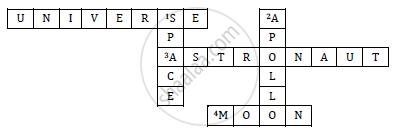
B4.
(i) For the first time, Neil Armstrong, Edwin Aldrin and Michael Collins were to land on the moon.
(ii) Armstrong found that his thumb was blotting out the Earth.
B5.
Yes, I would love to be an astronaut. Astronauts get the opportunity to travel to space. They collect
data and specimens needed for research work which is conducted for the benefit of the whole world.
APPEARS IN
संबंधित प्रश्न
Read the passage given below and answer the questions that follow:
1. Thackeray reached Kittur along with a small British army force and a few of his officers. He thought that the very presence of the British on the outskirts of Kittur would terrorise the rulers and people of Kittur and that they would lay down their arms. He was quite confident that he would be able to crush the revolt in no time. He ordered that tents be erected on the eastern side for the fighting forces and a little away on the western slopes tents be put up for the family members of the officers who had accompanied them. During the afternoon and evening of 20thOctober, the British soldiers were busy making arrangements for these camps.
On the basis of your understanding of the above passage complete the statements given below with the help of options that follow:
(ii) army officer
(iii) adviser to Rani of Kittur
(iv) treasury officer
(ii) enjoy life in tents
(iii) stay in the palace
(iv) give company to officers
(c) Why did Thackeray come to Kittur?
(d) Why did the Kittur officials refuse to give the desired assurance to Thackeray?
(e) What happened to the Horse Artillery?
(f) How do we know that the Rani was a noble queen?
(g) How in your opinion would the British women have felt after meeting the Rani?
(h) Why did the Rani refuse to meet Thackeray?
(i) Find words from the passage which mean the same as the following :
ii. aggressive/refusing to obey (para 2)
1. Read the passage given below :
1. Maharana Pratap ruled over Mewar only for 25 years. However, he accomplished so much grandeur during his reign that his glory surpassed the boundaries of countries and time turning him into an immortal personality. He along with his kingdom became a synonym for valour, sacrifice and patriotism. Mewar had been a leading Rajput kingdom even before Maharana Pratap occupied the throne. Kings of Mewar, with the cooperation of their nobles and subjects, had established such traditions in the kingdom, as augmented their magnificence despite the hurdles of having a smaller area under their command and less population. There did come a few thorny occasions when the flag of the kingdom seemed sliding down. Their flag once again heaved high in the sky thanks to the gallantry and brilliance of the people of Mewar.
On the basis of your understanding of the above passage answer each of the questions given below with the help of options that follow :
(ii) he added a lot of grandeur to Mewar.
(iii) of his valour, sacrifice and patriotism.
(iv) both (ii) and (iii)
(b) Difficulties in the way of Mewar were :
(ii) ancient traditions of the kingdom.
(iii) its small area and small population.
(iv) the poverty of the subjects.
(c) During thorny occasions :
(ii) the flag of Mewar was hoisted high.
(iii) the people of Mewar showed gallantry.
(iv) most of the rulers heaved a sigh of relief.
(d) Mewar was lucky because :
(ii) most of its people were competent.
(iii) most of its rulers were competent.
(iv) only a few of its people were incompetent.
Answer the following questions briefly:
(e) Who is the earliest king of Mewar mentioned in the passage?
(f) What was Rana Kumbha's contribution to the glory of Mewar?
(g) What does the writer find worth admiration in the people of Mewar?
(h) How could art and literature flourish in Mewar?
(i) How did the rulers show that they cared for their subjects?
(j) What does the erection of Vijaya Stambha and Kirti Stambha in the same fort signify ?
(k) Find words from the passage which mean the same as each of the following:
(ii) evidence (para 4)
Read the passage given below carefully :
1. For four days, I walked through the narrow lanes of the old city, enjoying the romance of being in a city where history still lives - in its cobblestone streets and in its people riding asses, carrying vine leaves and palm as they once did during the time of Christ.
2. This is Jerusalem, home to the sacred sites of Christianity, Islam and Judaism. This is the place that houses the church of the Holy Sepulchre, the place where Jesus was finally laid to rest. This is also the site of Christ's crucifixion, burial and resurrection.
3. Built by the Roman Emperor Constantine at the site of an earlier temple to Aphrodite, it is the most venerated Christian shrine in the world. And justifiably so. Here, within the church, are the last five stations of the cross, the 10th station where Jesus was stripped of his clothes, the 11th where he was nailed to the cross, the 12th where he died on the cross, the 13th where the body was removed from the cross, and the 14th, his tomb.
4. For all this weighty tradition the approach and entrance to the church is non-descript. You have to ask for directions. Even to the devout Christian pilgrims walking along the Via Dolorosa - the Way of Sorrows - first nine stations look clueless. Then a courtyard appears, hemmed in by other buildings and a doorway to one side. This leads to a vast area of huge stone architecture.
5. Immediately inside the entrance is your first stop. It's the stone of anointing: this is the place, according to Greek tradition, where Christ was removed from the cross. The Roman Catholics, however, believe it to be the spot where Jesus' body was prepared for burial by Joseph.
6. What happened next ? Jesus was buried. He was taken to a place outside the city of Jerusalem where other graves existed and there, he was buried in a cave. However, all that is along gone, destroyed by continued attacks and rebuilding; what remains is the massive - and impressive - Rotunda (a round building with a dome) that Emperor Constantine built. Under this, and right in the centre of the Rotunda. is the structure that contains the Holy Sepulchre.
7. "How do you know that this is Jesus' tomb ?" I asked one of the pilgrims standing next to me. He was clueless, more interested, like the rest of them, in the novelty of it all and in photographing it, then in its history or tradition.
8. At the start of the first century, the place was a disused quarry outside the city walls. According to the gospels, Jesus' crucifixion occurred 'at a place outside the city walls with graves nearby.....'. Archaeologists have discovered tombs from that era, so the site is compatible with the biblical period.
9. The structure at the site is a marble tomb built over the original burial chamber. It has two rooms, and you enter four at a time into the first of these, the Chapel of the Angel. Here the angel is supposed to have sat on a stone to recount Christ's resurrection. A low door made of white marble, party worn away be pilgrims' hands, leads to a smaller chamber inside. This is the 'room of the tomb', the place where Jesus was buried.
10. We entered in single file. On my right was a large marble slab that covered the original rock bench on which the body of Jesus was laid. A woman knelt and prayed. Her eyes were wet with tears. She pressed her face against the slab to hide them, but it only made it worse.
On the basis of your understanding of this passage answer the following questions with the help of given options:
(a) How does Jerusalem still retain the charm of ancient era?
(i) There are narrow lanes.
(ii) Roads are paved with cobblestones.
(iii) People can be seen riding asses
(iv) All of the above
(b) Holy Sepulchre is sacred to _________.
(i) Christianity
(ii) Islam
(iii) Judaism
(iv) Both (i) and (iii)
(c) Why does one have to constantly ask for directions to the church?
(i) Its lanes are narrow.
(ii) Entrance to the church is non-descript.
(iii) People are not tourist-friendly.
(iv) Everyone is lost in enjoying the romance of the place.
(d) Where was Jesus buried?
(i) In a cave
(ii) At a place outside the city
(iii) In the Holy Sepulchre
(iv) Both (i) and (ii)
Answer the following questions briefly:
(e) What is the Greek belief about the 'stone of anointing'?
(f) Why did Emperor Constantine build the Rotunda?
(g) What is the general attitude of the pilgrims?
(h) How is the site compatible with the biblical period?
(i) Why did the pilgrims enter the room of the tomb in a single file?
(j) Why did 'a woman' try to hide her tears?
(k) Find words from the passage which mean the same as:
(i) A large grave (para 3)
(ii) Having no interesting features/dull (para 4)
Read the first activity, read the extract and then do all the activities:
The next year Dell enrolled at the University of Texas. Like most first-year students, he needed to earn spending money. Just about everyone on campus was talking about personal computers. At the time, anyone who didn’t have a PC wanted one, but dealers were selling them at a hefty mark-up. People wanted low-cost machines custom-made to their needs, and these were not readily available. Why should dealers get such a big mark-up for so little added value ? Dell wondered. Why not sell from the manufacturer directly to the end user ?
Dell knew that IBM required its dealers to take a monthly quota of PCs, in most cases more than they could sell. He also knew that holding excess inventory was costly. So he bought dealers’ surplus stock at cost. Back in his dormitory room, he added features to improve performance. The improved models found eager buyers. Seeing the hungry market, Dell placed local advertisements offering his customized computers at 15 percent of retail price. Soon he was selling to businesses, doctors’ offices and law firms. The trunk of his car was his store; his room took on the appearance of a small factory.
During a holiday break, Dell’s parents told him they were concerned about his grades. “If you want to start a business, do it after you get your degree,” his father pleaded. Dell agreed, but back in college he felt the opportunity of a lifetime was passing him by. “I couldn’t hear to miss this chance,” he says. After one month he started selling computers again- with a vengeance.
A1. True / False - (2)
Rewrite the following sentences stating against each of them whether they are true or false :
(i) Dell bought computers directly from the IBM company.
(ii) Dealers were selling computers at high prices.
(iii) Dell’s father wanted Dell to get his degree.
(iv) Dealers disagreed to sell the surplus stock of computers to Dell.
A2. Give reasons - (2)
Dell wanted to stait a business of selling computers because :
(i) ____________
(ii) ____________
A3. Guess : (2)
“I couldn’t bear to miss this chance,” Dell says. Guess. which chance Dell did not want to miss”.
A4. Vocabulary - (2)
Find out the words from the extract which mean :
(i) college hall of residence
(ii) large amount added to the cost price
(iii) quantity of good in stock
(iv) with great intensity
A5. Personal response : (2)
Suggest two strategies businessman to become a successful businessman.
A6. Grammar - (2)
Rewrite the following sentences in the ways instructed :
(i) Seeing the hungry market, Dell placed local advertisement. (Make it a compound sentence)
(ii) He added features to improve performance. (Frame ‘Wh’ question to get the underlined part as an answer.)
Read the following extract and answer the questions given below:
But being named an 'AdarshGaon' is far from easy. Villages had to give a proposal after which a committee headed by Mr. Pawar inspected the villages. "The Villages had to show dedication in the struggle to fight mediocrity. They had to follow all the conditions of becoming an 'AdarshGaon'. We chose villages with a revolutionary spark, "Mr. Pawar says.
Villages need to follow strict rules. The process begins with effective water management through the watershed technique and water auditing. taking responsibility for the village's natural resources-planting trees and stopping grazing. contributing labour for the village work, and then expanding to bring about behavioral changes in the people for harboring social change. Hiware Bazaar is free of any kind of addiction and there are no liquor or tobacco shops in the village. Vasectomy has been made compulsory, as is the pre-marital HIV test.
The 'AdarshGaon' model prides itself on being based on the joint decisions made by the Gram Sabha, where all the villagers are present. Even while selecting the new villages under the scheme, Mr. Pawar made sure that the decision to become an ideal village was taken by the entire village together.
The greatest victory for Hiware Bazaar so far has been the reverse migration that the village has witnessed since 1989. As many as 93 families have come back to the village," from the slums in Mumbai and Pune," Mr. Pawar says.
Questions:
(1) What features of 'Adarsh Gaon' are given in this extract?
(2) What is the procedure for selecting 'Adarsh Gaon'?
(3) What is the greatest victory for Hiware Bazaar?
(4) Do you think all villages in Maharashtra should follow the ideals of Hiware Bazaar? why?
(5) Rewrite the following sentences in the ways instructed :
i. Mr. Pawar inspected the villages.
(Rewrite it using the noun form of the word underlined.)
ii. Vasectomy has been made compulsory by the villagers.
(Rewrite it beginning with-"The villagers........".)
iii. There are no liquor or tobacco shops in the village.
(Rewrite it using 'neither......nor'.)
(6) Find out the words from the extract which mean:
(i) causing a great change
(ii) the quality of being average
A Read the first activity, read the extract and then do all the activities :
A1. Complete :
Complete the following sentences :
(1) The two organizations that conducted the research to develop a smartphone-based optical bio-sensor are _______ and __________ .
(2) The _________ and _________ methods were used in the research instead of the differential method.
|
Urea is a major product of nitrogen metabolism in humans. It is eliminated from the body mainly by the kidneys through urine. Urea levels in body fluids, such as blood and saliva, rise drastically under certain kidney dysfunctions. Heart failure, hypovolemic shock, gastrointestinal bleeding, and severe infections can also lead to a rise. Thus urea in blood and saliva provides key information on renal function and helps diagnose various disorders. Most methods for estimating urea in body fluids are based on colorimetry. These methods are time-consuming and involve painful blood extraction. Collecting saliva is non-evasive and research has correlated salivary and blood urea levels. Recently scientists from the IIT-D and the AIIMS, New Delhi successfully developed a smartphone-based optical biosensor to detect urea in saliva. To fabricate the sensor, they directly immobilised the urease enzyme with a pH indicator on a filter paper-based strip. As a response to the urea on saliva, the paper strip changes colour. The red, green and blue levels help measure urea concentration. The scientists used the slope method, sensor response change per unit time, instead of the differential method, the difference in sensor response between two-time intervals, to increase sensitivity and eliminate interference by variations in ambient light. The team clinically validated spiked saliva samples and samples from healthy volunteers. The smartphone application with paper strip can even be operated by non-professional with limited training. This saves time and cost spent on bulky spectroscopic procedures. The report can revolutionise the medical screening of large populations. And such mass screening of diseases would boost national health. |
A2. Complete the following sentence using the correct alternatives from those given below :
Two objectives to conduct the research are ___________ .
(i) The colorimetry method used to estimate urea in body fluids consumes more time.
(ii) Information obtained from the presence of urea in blood and saliva is not helpful to diagnose various diseases.
(iii) Collecting samples of saliva is a non-invasive procedure.
(iv) Blood extraction is the easiest and less painful exercise.
A3. Write two benefits of the smartphone-based optical biosensor.
A4. Find out similar-meaning words from the extract for the following words :
(1) specimen (2) extremely (3) focus (4) remove
A5. Personal Response :
'Research revolutionises the lifestyle of people in all spheres of life'-
Do you agree? Explain with an example in about 25 words.
A6. Grammar :
Rewrite the following sentences in the ways instructed :
(1) These methods are time consuming and painful.
(Rewrite the sentence using 'as well as'.)
(2) The smartphone application with paper-strip can be operated.
(Begin the sentence with 'They ___ .)
(B) Summerise the above extract with the help of the points given and suggest a suitable title::
Research by the organisations - methods adopted - reasons for the research - advantages.
Read the extract and complete the activities given below :
Luxurious houses on the edge of a big city which one promoter sold with the tagline ‘‘Where Nature peeps through every window.’’ All the advantages of a modern lifestyle but with the added bonus of fresh air. But nature isn’t greenery alone; it also includes wild animals.
While the view from the picture windows was easy on the eye, occasionally, it made them gulp with nervousness. At dusk, wild cats leaped out of the adjoining forest on to the top of the peripheral walls and strolled nonchalantly. Sometimes, they lounged on ledges with their long tails swinging freely, oblivious of the many worried human eyes pinned on them. Their cold yellow aggressive eyes turned black as their pupils dilated with failing light.
Some Mumbaikars paid a lot of money to see leopards on safari in Africa. But to watch them from one’s own home was disconcerting. These predators were out of line, stepping off nature into the city. Why did the leopards not stay within the 100-square kilometre Sanjay Gandhi National Park? Perhaps, the leopards thought that if people could venture into nature to jog, walk and picnic, why couldn’t they hang around apartment blocks? If people could enjoy nature, couldn’t nature savour humanity’s offerings?
Capturing leopards is extraordinarily simple. These curious cats seem incapable of resisting a free meal, walking into baited traps without hesitation. The reason the felines are attracted to their residential community is prey : stray dogs that live on rubbish heaps. Taking care of the food source is the best course of action, the volunteers said.
A1. Rewrite the following sentences as per their occurrence in the extract :
- Instead of capturing leopards we can take care of their food.
- Leopards leave their habitat and enter the human habitat.
- Modern lifestyle and nature both attract the dwellers.
- Leopards can enjoy human surroundings by leaving nature.
A2. Complete the following sentences :
- Nature is a combination of ______ and ______
- The best of both the worlds include ______ and ______
- The wild animals are out of line as ______
- The wild cats are attracted towards residential areas because ______
A3. Find out the words for leopards used in the extract :
- ____________
- ____________
- ____________
- ____________
A4. ‘‘If people could venture into nature to jog, walk, and picnic, why couldn’t the wild animals hang around apartment blocks?’’ Express your opinion.
A5. Rewrite the following sentences in the ways instructed :
- Taking care of the food source is the best course of action.
(Use infinitive form of the underlined word and rewrite.) -
Nature isn’t greenery alone; it also includes wild animals.
(Rewrite it by using ‘not only ... but also’.)
A6. Find a word for each of the following expressions from the extract :
- Enjoy the taste of something
- Embarrassing and confusing to watch
- Not conscious or aware of something or someone
- Relaxed and in an unworried manner
Read the following excerpt from a case study.
| Impacts of Festivities on Ecology | |||||||||||||||||||||||||||||
| 5 | Festivals are synonymous with celebration, ceremony and joy. However, festivals bring to the fore the flip side of celebrations – pollution – air, water, soil and noise. This led to the need of assessing the awareness level among people about ecological pollution during festivals. So, a study was conducted by scholars of an esteemed university in India. This study was titled Awareness Towards Impact of Festivals on Ecology. | ||||||||||||||||||||||||||||
| 10 | There were two main objectives of the study. The first one was to assess the awareness level among people about ecological protection during festivities. Exploring solutions to bring awareness about celebrating festivals without harming ecology was the second objective. The method used to collect data was a simple questionnaire containing 6 questions, shared with 50 respondents across four selected districts of a state in the southern region of India. | ||||||||||||||||||||||||||||
| 15 |
The research began by understanding the socio-economic conditions of the respondents before sharing the questionnaire. Once the responses were received, the data collected were tabulated (Table 1), for analysis. Table-1: Awareness level among respondents
|
||||||||||||||||||||||||||||
| 20 | The study recommended the imposition of strict rules and regulations as opposed to a total ban on all festive activities which have a drastic impact on our environment. The researchers believed that such measures would help in harnessing some ill-effects that add to the growing pollution and suggested further studies be taken up across the country to assess awareness about ecological degradation. | ||||||||||||||||||||||||||||
| 25 | The observations made in the study pointed to the environmental groups and eco-clubs fighting a losing battle due to city traffic issues, disposal of plastics, garbage dumping and all sorts of ecological degradation. The researchers stressed that the need of the hour is increasing awareness among people to reduce environmental pollution which can be facilitated by celebrating all festivals in an eco-friendly manner. | ||||||||||||||||||||||||||||
On the basis of your understanding of the passage, answer the questions given below.
- Why do the researchers call pollution the ‘flip side’ of festivals?
- Comment on the significance of the second objective of the study with reference to lines 7-12.
- Justify the researchers’ recommendation for limiting the drastic impact of festival pollution on the environment with reference to lines 16-21.
- Why do the researchers feel that environmental groups and eco-clubs are fighting a losing battle in the given scenario?
- Even though a larger number of people say ‘no’ to bursting crackers than those who say ‘yes’, festival pollution persists. How does evidence from table 1 support this statement?
- What purpose does the ‘Can’t Say’ column serve in the questionnaire (table 1)?
Based on the careful reading of the passage given below, answer any four out of five questions that follow:
|
Climate change and global warming are the biggest threats of the present time and how the world manages to control pollution will define our future. Rising industrialization, urbanization, deforestation etc., are endangering the natural ecosystem. Since 1880, the earth’s temperature has been rising at a rate of 0.14° F (0.08° C) per decade and the rate of increase has doubled since 1981 at 0.32° F (0.18° C) per decade. The 10 warmest years on record have occurred since 2015, with 2020 recorded as the second-warmest year as per the National Oceanic and Atmospheric Administration (NOAA). With growing economies, global carbon measurements have been rapidly rising for the last 15 years. As per recent data, in January 2022, carbon dioxide (CO2) measurement stood at 418 parts per million, up around 11% from 378 parts per million recorded since 2007. |
(a) What is the key to defining our future?
- The means employed to control pollution.
- The means employed to control resources.
- The means employed to control state policies.
- The means employed to educate masses.
(b) Which of the following elements are not responsible for endangering natural ecosystem?
- Deforestation
- Inflation
- Industrialization
- Urbanization
(c) According to the passage, economy, and carbon emissions have been ______ to each other for last 15 years.
- Inversely proportionate
- Directly proportionate
- Not related
- Disproportionate
(d) Name the institution responsible for observing and recording earth’s temperature over the years.
- National Organic and Atmospheric Administration
- National Oceanic and Atmospheric Administration
- North Organic and Atmospheric Administration
- National Offshore and Atmospheric Administration
(e) Carbon dioxide measurement stood at ______ parts per million in 2007.
- 387
- 378
- 481
- 418
Read the following text.
|
|
Arthur lay in his cabin, still trying to piece together the events of the last few hours. He had watched his home planet of Earth be demolished to make way for a hyperspace bypass, been saved by his friend Ford, and then whisked away on a ship that was powered by an "infinite improbability drive." It was all too much for him. |
|
5. |
Just then, Ford stuck his head around the door. |
|
10 |
"What's that?" asked Arthur. |
|
15 |
"I don't know," said Arthur. "I don't think I really understand anything anymore. Why is a mouse the ship's computer?" |
|
20 |
Arthur was about to say something, but at that moment the ship's intercom crackled to life. |
|
25 |
"Eddie, would you mind shutting up?" said Arthur. |
|
30 |
"It's me," said the voice. "Marvin." |
|
35 |
Arthur looked down and saw a small, metal figure shuffling across the floor. It was about three feet tall, with a round head and a body that looked like it had been cobbled together from spare parts. Its eyes were a dull red, and its voice was a monotone. |
Answer the following questions, based on the passage above.
- Select the option that classifies Arthur's confusion about drastic events such as the destruction of his home planet and the introduction of new technologies, correctly. (1)
- Routine and boredom
- Adventure and excitement
- Loss and change
- Calm and relaxation
- What is the significance of the white lab mouse in the control room of the Heart of Gold spaceship? (1)
- It is the captain of the ship
- It serves as the ship's computer
- It is a pet of the crew
- It is used for scientific experiments
- Share evidence from the text, in about 40 words to support the view that the writer’s writing style is descriptive and humourous. (2)
- Complete the sentence appropriately with a characteristic or its description. (1)
Based on the information given in the excerpt, one can infer that the mice who built the Earth are ______. - Select the option that is similar in meaning to Ford’s expression, “Pretty neat, huh?". (1)
- Easy, isn’t it?
- Could be worse, no?
- Impressive, yes?
- Too difficult for you?
- Explain, in about 40 words, why the name "The Paranoid Android" is considered ironic. (2)
- In the line, “…a body that looked like it had been cobbled together from spare parts…”, what comparison does the word “cobbled” refer to? (1)
- How does the following, impact the reader, even though they know Marvin is just an android? (2)
"I've been waiting for someone to talk to me for over two million years," said Marvin. Answer in about 40 words. - Read the five headlines (a) -(e), given below: (1)
(a) HUMANITY'S JOURNEY WITNESSED BY A DEPRESSED ROBOT
(b) HITCHHIKING THROUGH SPACE: A COMICAL TAKE ON THE END OF THE WORLD
(c) NEW STUDY FINDS ALIENS LIVING AMONG US
(d) GROUNDBREAKING TECHNOLOGY WILL SOON ENABLE TIME TRAVEL
(e) INTERGALACTIC TRAVEL VIA NEW INFINITE IMPROBABILITY DRIVE
Identify the option that displays the headline/s that DOES/ DO NOT correspond with occurrences in the passage.- Only (a)
- (b) (c) and (d)
- Only (e)
- (a) and (e)
