Advertisements
Advertisements
Question
Read and understand the data presented in the pie-chart below on factors affecting health, and write an article for your school magazine highlighting the fact that it’s our lifestyle that determines how healthy we remain. Write your article in about 150 words. Give a suitable title too.

The factors which affect health are given percentage-wise in the pie chart.
Advertisements
Solution
Cause For Diseases
For a billion-plus population in India, the medical facilities are restricted to only 10% of the population. As the poorest of the poor ‘ can’t afford to buy health services, their health gets affected and they die early. The pollution levels in all the metropolitan cities are growing to alarming levels. Lung-related diseases are caused by the toxic fumes released by two-wheelers and four-wheelers. The study reveals 19% of diseases are caused due to pollution. Of course, there are 20% of diseases genetically inherited from parents. TB and diabetes are said to be some of the inherited diseases.
Now doctors are trying to isolate the gene that causes terminal illness and correct it during pregnancy itself. Such advanced health care and preventive support may not be available for poor countries. 51% of the causes of illness are jointly shared by lifestyle, smoking, obesity, stress, diet, nutrition, and blood pressure. Lifestyle and stress are interrelated.
Hectic work schedules, lack of sleep, eating disorders contribute to stress and high level of blood pressure. Due to addiction to android games and TV shows, young ones neglect to play on open grounds. They are glued to small or big screens and keep eating chips, fries, and heavily advertised junk food. Poor people don't give nutritious food to children. Malnourishment leads to various diseases. Some children lose their eyesight due to vitamin deficiency. Politicians should focus on investing money in sports and games and health care delivery systems that give good health care to all freely.
APPEARS IN
RELATED QUESTIONS
Read the following extract carefully and present the information in the form of notes with the help of the given clues :
Sarvepalli Radhakrishnan was the first Vice President and second President of India.
He was a teacher, a philosopher and 'an author. He had introduced the thinking of Western idealist philosophers like Plato, Plontinus, Bergson into Indian thought.
He was born on 5th of September, 1888 in a poor Brahmin family. As his father could not afford his education expenses, Radhakrishnan supported most of his education
through scholarships. He completed his B.A. and M.A. with majors in philosophy. He went on to become a professor of philosophy. He showed that Indian Philosophy, once translated into standard academic jargon, is worthy of being called philosophy by Western standards.
He thus, placed Indian Philosophy on world map.
Sarvepalli Radhakrishnan had established a strong relationship with the Soviet Union when he w Is appointed as the ambassador to the Soviet Union.
He has been honoured with many awards for his achievements nationally and internationally. He was honoured with the Bharat Ratna in 1954. He is also acknowledged with the Templeton Prize, Peace Prize of German Book Trade, Order of Merit and many other honours.
Title : Sarvepalli Radhakrishnan
Birth : 5th September, 1888
Qualifications : B.A. ___________
Introduced thinking of : _________,_________and ____ into Indian thought.
Work : Translated_____________ into standard____________
Ambassador : __________________________________
Honours : National___________
International Order of Merit
What is universal about the theme – that is, what can we all learn from the poem?
What brought the six humans together? Where were they?
Anderson through the story a Little Match Girl gives an idea about the Victorian society of his times?
Answer the following questions with reference to Ray Douglas Bradbury’s short story, ‘All Summer in a Day’:
Why was there so much excitement in the schoolroom that morning? What sets Margot apart from the other children?
What is the poet’s feeling towards childhood?
Who were the other two spectators? What did they do? (Did they watch, or did they join in the fight?
Find words in the story, which show things striking violently against each other.
The crow and the myna c_ll____in mid-air.
Frame a pointwise Analysis of the poem ‘The worm’. Use the following points.
- Poem and poet:
- Theme:
- Tone:
- Structure and stanzas:
- Rhyme and Rhythm:
- Language and Imagery:
- Figures of Speech:
Discuss with your partner and match the following expressions given in column A with their interpretations in column 'B'.
| Sr.No. | A | B |
| 1. | While Chief Baron Ear sat to balance the laws. | (a) Eyes are refrained from using spectacles. |
| 2. | They are made with the straddle as wide as the ridge of the Nose is. | (b) The responsibility of giving a verdict rested on the shoulders of the hearing organ. |
| 3. | That whenever the Nose put his Spectacles on, by daylight or candlelight Eyes should be shut! | (c) Spectacles are meant for none other than the nose. |
| 4. | So his lordship decreed with a grave solemn tone, decisive and clear, without one if or but. | (d) The judge delivered a firm verdict without any doubt. |
Place the given areas of questioning from the list in the appropriate columns.
- future plans
- inspiration
- overcoming hurdles/ struggle
- coach/ mentor/ guide/ teacher
- message for the youngsters
- family support
- alternate career choice
- first or maiden award/ achievement /success /setbacks
- a turning point in life/ success formula/technique.
| Section of the interview | Aspects to be covered | |
| 1. | Introduction | Welcoming/Greeting, Introduction of the guest/Occasion. |
| 2. | Opening questions | |
| 3. | Main body | |
| 4. | Concluding questions | |
| 5. | Summing up | Concluding the statement, Expressing gratitude. |
You can add your points.
Gather information on any one of the following by talking to your elders, family members, and from other sources in your mother tongue and write a short note on it in English.
A special dish that is prepared on a special occasion at home.
Form pairs. List the things on which you have the same opinion and also the ones on which you have different opinions. Prepare a list of ten things in all and see how far you agree or disagree with your friend. Some useful phrases are given alongside. You could talk about:
- Clothes, latest fashion.
- Performance of sportsmen and women.
- Traffic/Transport in your area.
- Cleanliness and hygiene in your area.
- Future occupations/Careers.
- Latest news items.
- TV programs
- Mobile Apps
- Any subject of your choice.
| Agreement | Ask for your friend’s opinion: | Disagreement |
| I totally agree with you. | Do you think ...? | No, I don’t think so. |
| Exactly/Absolutely! | Do you agree ...? | I totally disagree. |
| You are right. | What do you think? | Not necessarily. |
| I don’t know, I need to think about it. (partial agreement) | What is your opinion? | I’m not sure about that. |
| I suppose so. | How do you feel about that? | Let’s agree to disagree! |
Name the occasion or reason for which the announcements are being made. Then think of an occasion and prepare an announcement for it as a group activity.
Drafting a Speech. Discuss in groups each block and make notes about it.

‘What Men Can Do, Women can do better’ Divide your class in 2 groups. Let one group offer points ‘For the topic’ and the other, ‘Against the topic.’ Note down the points in your notebooks, expand the points in two separate paragraphs of about 15 to 20 lines each. Suggest suitable titles for each.
Taking clues from the lists on the board, complete the following chart.

Read the jumbled lines from the poem and rearrange them in correct order.
| 1. cinnamon, betel leaves |
| 2. and ginger and garlic” |
| 3. Go to Muthu’s |
| 4. My mother would say: |
| 5. and get some |
| 6. “Little boy Raj… |
| 7. And so I go to the shops |
| 8. singing all the way |
| 9. tomatoes and pickles” |
| 10. “Sesame seeds, onions |
| 11. I rattle off a list: |
| 12. what I’d want |
| 13. and when Muthu asks me |
| 14. my mother twists my ear |
| 15. and back home |
| 16. ouch! |
Use the option to fill in the blank.
My toys ______broken.
Using a red pencil, choose and circle the things whose smell you like. Now with a blue pencil circle the things whose smell you do not like. Make five sentences like this
I like/do not like the smell of ______ because it reminds me of______.
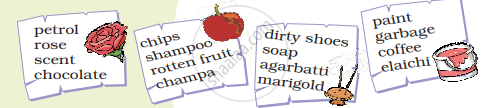
- ______.
- ______.
- ______.
- ______.
- ______.
What did Hiawatha love?
What made the dogs follow the grandmother after school hours?
State whether the following statement are true or false
The friends parted one night after watching a movie together.
Write an application for the post of Personal Secretary to the Managing Director of a company. Include the following details: Educational qualification, experience, various other qualifications required for the post.
Imagine someone has invited your family to a programme and you were the only person at home when the invitation was given orally.
Write a note (4-5 lines) to pass on the message to the other people in your family. Or, Write an imaginary conversation in which you pass on the message to your parents.
Discuss the following and write the summary of your discussion in the form of bullet points.
- How are certain ideas/customs/knowledge passed on from one generation to the next?
- Is it necessary for children to follow the footsteps of their forefathers? If yes, why? Why is it sometimes necessary to change the old ways?
What might success mean to the following people? Think about it and write.
A businessman
Can you think of any events in your own or someone else’s life to support the quote-
‘If you tell the truth, you don’t have to remember anything.’
What is likely to happen if you don’t tell the truth?’
Write a composition (in approximately 400-450 words) on the following subject:
Cooking should be made a compulsory subject in the higher classes. Argue either FOR or AGAINST the given statement.
Read the passage given below and answer the questions (i), (ii) and (iii) that follow.
| (1) | “Can I see the Manager?” I said, and added solemnly, “Alone.” I don't know why I said “Alone.” “Certainly,” said the accountant and fetched him. | |
| (2) | The Manager was a grave, calm man. I held my fifty-six dollars clutched in a crumpled ball in my pocket. “Are you the Manager?” I asked. God knows I did not doubt it. “Yes,” he said. “Can I see you …. alone?” I asked. |
5 |
| (3) | The Manager looked at me in some alarm. He felt that I had an awful secret to reveal. “Come in here,” he said, and led the way to a private room. He turned the key in the lock. “We are safe from interruption here,” he said; “Sit down.” We both sat down and looked at each other. I found no voice to speak. “You are one of Pinkerton’s men, I presume,” he said. |
10 |
| (4) |
He had gathered from my mysterious manner that I was a detective. I knew what he was thinking, and it made me worse. |
15
20
|
| (5) | The Manager got up and opened the door. He called to the accountant. “Mr. Montgomery,” he said unkindly loud, “this gentleman is opening an account, he will deposit fifty-six dollars. Good morning.” I rose. A big iron door stood open at the side of the room. “Good morning,” I said, and stepped into the safe. “Come out,” said the Manager coldly and showed me the other way. |
30 |
| (6) | I went up to the accountant’s wicket and poked the ball of money at him with a quick convulsive movement as if I were doing a conjuring trick. My face was ghastly pale. “Here,” I said, “deposit it.” The tone of the words seemed to mean, “Let us do this painful thing while the fit is on us.” He took the money and gave it to another clerk. |
35 |
| (7) | He made me write the sum on a slip and sign my name in a book. I no longer knew what I was doing. The bank swam before my eyes. “Is it deposited?” I asked in a hollow, vibrating voice. “It is,” said the accountant. “Then I want to draw a cheque.” My idea was to draw out six dollars of it for present use. Someone gave me a chequebook through a wicket and someone else began telling me how to write it out. The people in the bank had the impression that I was an invalid millionaire. I wrote something on the cheque and thrust it in at the clerk. He looked at it. |
40
45 |
| (8) | “What! Are you drawing it all out again?” he asked in surprise. Then I realised that I had written fifty-six instead of six. I was too far gone to reason now. I had a feeling that it was impossible to explain the thing. I had burned my boats. All the clerks had stopped writing to look at me. Reckless with misery, I made a plunge. “Yes, the whole thing.” “You withdraw all your money from the bank?” “Every cent of it.” “Are you not going to deposit anymore?” said the clerk, astonished. “Never.” |
50
55 |
| (9) | An idiot hope struck me that they might think something had insulted me while I was writing the cheque and that I had changed my mind. I made a wretched attempt to look like a man with a fearfully quick temper. | |
| (10) | The clerk prepared to pay the money. “How will you have it?” he said. This question came as a bolt from the blue. “What?” “How will you have it?” “Oh!”— I caught his meaning and answered without even trying to think— “in fifties.” He gave me a fifty-dollar bill. “And the six?” he asked dryly. “In sixes,” I said. He gave it to me and I rushed out. As the big door swung behind me. I caught the echo of a roar of laughter that went up to the ceiling of the bank. Since then, I bank no more. I keep my money in cash in my trousers pocket and my savings in silver dollars in a sock. |
60
65
70 |
| Adapted from: My Financial Career By Stephen Leacock |
||
-
- Find a single word from the passage that will exactly replace the underlined word or words in the following sentences. [3]
- The kind stranger went and got back the ball from where it had rolled into the bush.
- I took offence at the expression on his face that was clearly meant to insinuate I was a liar.
- The firm experienced a financial loss when the contract went to a contender who had just entered the business.
- For each of the words given below, choose the correct sentence that uses the same word unchanged in spelling, but with a different meaning from that which it carries in the passage. [3]
- alarm (line 8)
- The silence from the other end set off alarm bells in her head.
- The pallor of his skin alarmed those standing around.
- I set my alarm for six o’clock but slept through it.
- The sound of the approaching jets caused some alarm in the war room.
- wicket (line 44)
- The wicketkeeper was the true saviour of the day for that one match.
- The team wanted to bat while the wicket was still dry.
- The man at the window handed us our tickets through the wicket.
- The quick loss of wickets demoralised the team.
- reason (line 48)
- After the tragedy, his ability to reason is severely diminished.
- They reasoned they could get better seats if they arrived early.
- Recipients of funds were selected without rhyme or reason.
- We have every reason to celebrate.
- alarm (line 8)
- Find a single word from the passage that will exactly replace the underlined word or words in the following sentences. [3]
- Answer the following questions as briefly as possible in your own words.
- With reference to the passage, explain the meaning of the expression of the ‘I had burned my boats?’ [2]
- Cite any two instances of the behaviour of the bank employees that indicate the insignificance of a deposit of fifty-six dollars. [2]
- Why do you think the people in the bank thought of the narrator as an “invalid millionaire?” [2]
- Summarise why the narrator decided ‘to bank no more’ (paragraphs 6 to 10). You are required to write the summary in the form of a connected passage in about 100 words. Failure to keep within the word limit will be penalised. [8]
