Advertisements
Advertisements
Question
Prove that `cos^(-1) 4/5 + cos^(-1) 12/13 = cos^(-1) 33/65`.
Advertisements
Solution
Let `cos^(-1) 4/5 = x`.
Then, `cos x = 4/5`
⇒ `sin x = sqrt (1 - (4/5)^2)`
⇒ `sin x = sqrt(1 - 16/25)`
⇒ `sin x = sqrt(9/25)`
⇒ `sin x = 3/5`
∴ `tan x = 3/4` ⇒ `x = tan^(-1) 3/4`
∴ `cos^(-1) 4/5 = tan^(-1) 3/4` ...(1)
Now, let `cos^(-1) 12/13 = y`.
Then, `cos y = 12/13`
⇒ `sin y = 5/13`
∴ `tan y = 5/12` ⇒ `y = tan^(-1) 5/12`
∴ `cos^(-1) 12/13 = tan^(-1) 5/12` ...(2)
Let `cos^(-1) 33/65 = z`.
Then, `cos z = 33/65`
⇒ `sin z = 56/65`
∴ `tan z = 56/33` ⇒ `z = tan^(-1) 56/33`
∴ `cos^(-1) 33/65 = tan^(-1) 56/33` ...(3)
Now, we will prove that:
L.H.S = `cos^(-1) 4/5 + cos^(-1) 12/13`
= `tan^(-1) 3/4 + tan^(-1) 5/12` ...[Using (1) and (2)]
= `tan^(-1) (3/4 + 5/12)/(1 - 3/4 * 5/12)` ...`[tan^(-1) x + tan^(-1) y = tan^(-1) (x + y)/(1 - xy)]`
= `tan^(-1) (36+20)/(48-15)`
= `tan^(-1) 56/33`
= `tan^(-1) 56/33` ...[By (3)]
= R.H.S.
APPEARS IN
RELATED QUESTIONS
Prove that `cot^(-1)((sqrt(1+sinx)+sqrt(1-sinx))/(sqrt(1+sinx)-sqrt(1-sinx)))=x/2;x in (0,pi/4) `
Solve for x : tan-1 (x - 1) + tan-1x + tan-1 (x + 1) = tan-1 3x
If `tan^-1(2x)+tan^-1(3x)=pi/4`, then find the value of ‘x’.
Prove `2 tan^(-1) 1/2 + tan^(-1) 1/7 = tan^(-1) 31/17`
Write the following function in the simplest form:
`tan^(-1) x/(sqrt(a^2 - x^2)), |x| < a`
Find the value of the given expression.
`tan^(-1) (tan (3pi)/4)`
Find the value of the given expression.
`tan(sin^(-1) 3/5 + cot^(-1) 3/2)`
Prove `tan^(-1) 1/5 + tan^(-1) (1/7) + tan^(-1) 1/3 + tan^(-1) 1/8 = pi/4`
sin (tan–1 x), |x| < 1 is equal to ______.
Solve `tan^(-1) - tan^(-1) (x - y)/(x+y)` is equal to
(A) `pi/2`
(B). `pi/3`
(C) `pi/4`
(D) `(-3pi)/4`
Prove that `3sin^(-1)x = sin^(-1) (3x - 4x^3)`, `x in [-1/2, 1/2]`
Find the value of the expression in terms of x, with the help of a reference triangle
`tan(sin^-1(x + 1/2))`
Find the value of `cot[sin^-1 3/5 + sin^-1 4/5]`
Prove that `tan^-1x + tan^-1y + tan^-1z = tan^-1[(x + y + z - xyz)/(1 - xy - yz - zx)]`
Solve: `cot^-1 x - cot^-1 (x + 2) = pi/12, x > 0`
Choose the correct alternative:
If `cot^-1(sqrt(sin alpha)) + tan^-1(sqrt(sin alpha))` = u, then cos 2u is equal to
Choose the correct alternative:
The equation tan–1x – cot–1x = `tan^-1 (1/sqrt(3))` has
Prove that `2sin^-1 3/5 - tan^-1 17/31 = pi/4`
The value of the expression `tan (1/2 cos^-1 2/sqrt(5))` is ______.
If cos–1x > sin–1x, then ______.
The value of cos215° - cos230° + cos245° - cos260° + cos275° is ______.
The minimum value of sinx - cosx is ____________.
The value of `"tan"^-1 (1/2) + "tan"^-1 (1/3) + "tan"^-1 (7/8)` is ____________.
`"sin" {2 "cos"^-1 ((-3)/5)}` is equal to ____________.
The value of expression 2 `"sec"^-1 2 + "sin"^-1 (1/2)`
`"cot" ("cosec"^-1 5/3 + "tan"^-1 2/3) =` ____________.
The value of `"tan"^-1 (1/2) + "tan"^-1(1/3) + "tan"^-1(7/8)` is ____________.
`"cos"^-1["cos"(2"cot"^-1(sqrt2 - 1))]` = ____________.
If `6"sin"^-1 ("x"^2 - 6"x" + 8.5) = pi,` then x is equal to ____________.
`"tan"^-1 (sqrt3)`
If `"sin" {"sin"^-1 (1/2) + "cos"^-1 "x"} = 1`, then the value of x is ____________.
If `3 "sin"^-1 ((2"x")/(1 + "x"^2)) - 4 "cos"^-1 ((1 - "x"^2)/(1 + "x"^2)) + 2 "tan"^-1 ((2"x")/(1 - "x"^2)) = pi/3` then x is equal to ____________.
The Government of India is planning to fix a hoarding board at the face of a building on the road of a busy market for awareness on COVID-19 protocol. Ram, Robert and Rahim are the three engineers who are working on this project. “A” is considered to be a person viewing the hoarding board 20 metres away from the building, standing at the edge of a pathway nearby. Ram, Robert and Rahim suggested to the firm to place the hoarding board at three different locations namely C, D and E. “C” is at the height of 10 metres from the ground level. For viewer A, the angle of elevation of “D” is double the angle of elevation of “C” The angle of elevation of “E” is triple the angle of elevation of “C” for the same viewer. Look at the figure given and based on the above information answer the following:
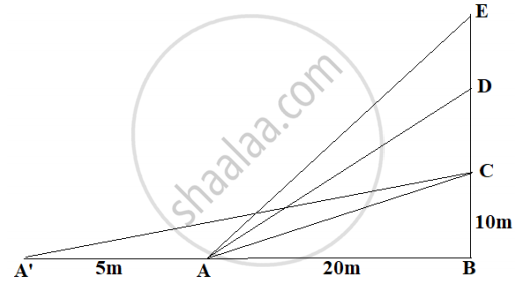
Measure of ∠CAB = ________.
What is the value of cos (sec–1x + cosec–1x), |x| ≥ 1
What is the simplest form of `tan^-1 sqrt(1 - x^2 - 1)/x, x ≠ 0`
`sin^-1(1 - x) - 2sin^-1 x = pi/2`, tan 'x' is equal to
The value of cosec `[sin^-1((-1)/2)] - sec[cos^-1((-1)/2)]` is equal to ______.
