Advertisements
Advertisements
Question
Prove that `(1 + sin "B")/"cos B" + "cos B"/(1 + sin "B")` = 2 sec B
Advertisements
Solution
L.H.S = `(1 + sin "B")/"cos B" + "cos B"/(1 + sin "B")`
= `((1 +sin "B")^2 + cos^2"B")/(cos "B"(1 + sin "B"))`
= `(1 +2sin"B" + sin^2"B" + cos^2"B")/(cos"B"(1 + sin"B"))` ......[∵ (a + b)2 = a2 + 2ab + b2]
= `(1 + 2sin"B" + 1)/(cos"B"(1+ sin"B"))` .....[∵ sin2B + cos2B = 1]
= `(2 + 2sin"B")/(cos"B"(1 + sin"B"))`
= `(2(1 + sin"B"))/(cos"B"(1 + sin"B"))`
= `2/"cos B"`
= 2 sec B
= R.H.S
∴ `(1 + sin "B")/"cos B" + "cos B"/(1 + sin "B")` = 2 sec B
APPEARS IN
RELATED QUESTIONS
Prove that sin6θ + cos6θ = 1 – 3 sin2θ. cos2θ.
If acosθ – bsinθ = c, prove that asinθ + bcosθ = `\pm \sqrt{a^{2}+b^{2}-c^{2}`
(secA + tanA) (1 − sinA) = ______.
Prove the following identities, where the angles involved are acute angles for which the expressions are defined:
`(tan theta)/(1-cot theta) + (cot theta)/(1-tan theta) = 1+secthetacosectheta`
[Hint: Write the expression in terms of sinθ and cosθ]
Prove that `(tan^2 theta)/(sec theta - 1)^2 = (1 + cos theta)/(1 - cos theta)`
Prove the following trigonometric identities.
(cosec θ − sec θ) (cot θ − tan θ) = (cosec θ + sec θ) ( sec θ cosec θ − 2)
Prove the following identities:
`cot^2A((secA - 1)/(1 + sinA)) + sec^2A((sinA - 1)/(1 + secA)) = 0`
Prove the following identities:
sec4 A (1 – sin4 A) – 2 tan2 A = 1
If tan A = n tan B and sin A = m sin B, prove that `cos^2A = (m^2 - 1)/(n^2 - 1)`
`sqrt((1+cos theta)/(1-cos theta)) + sqrt((1-cos theta )/(1+ cos theta )) = 2 cosec theta`
If x=a `cos^3 theta and y = b sin ^3 theta ," prove that " (x/a)^(2/3) + ( y/b)^(2/3) = 1.`
If `tan theta = 1/sqrt(5), "write the value of" (( cosec^2 theta - sec^2 theta))/(( cosec^2 theta - sec^2 theta))`.
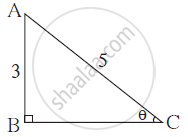
From the figure find the value of sinθ.
If a cos θ + b sin θ = 4 and a sin θ − b sin θ = 3, then a2 + b2 =
If a cos θ − b sin θ = c, then a sin θ + b cos θ =
Prove that:
(cosec θ - sinθ )(secθ - cosθ ) ( tanθ +cot θ) =1
Prove the following identity :
`sec^2A.cosec^2A = tan^2A + cot^2A + 2`
If cosθ + sinθ = `sqrt2` cosθ, show that cosθ - sinθ = `sqrt2` sinθ.
Simplify (1 + tan2θ)(1 – sinθ)(1 + sinθ)
tan θ × `sqrt(1 - sin^2 θ)` is equal to:
