Advertisements
Advertisements
Question
Pressure at the free surface of a water lake is P1, while at a point at depth h below its free surface is P2. (a) How are P1 and P2 related? (b)Which is more P1 or P2?
Advertisements
Solution
(a) P2 = P 1 + h ρ g ,
(b) P2 > P 1
RELATED QUESTIONS
Explain why an iron needle sinks in water, but a ship made of iron floats on water.
For a given object, the buoyant force in liquids of different ______ is ______.
The diagram below in Fig. 4.12 shows a device which makes the use of the principle of transmission of pressure.
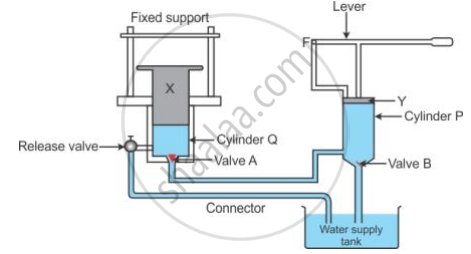
- Name the parts labelled by the letters X and Y.
- Describe what happens to valves A and B and to the quantity of water in the two cylinders when the lever arm is moved down.
- Give reasons for what happens to valves A and B in part (ii).
- What happens when the release valve is opened?
- What happens to valve B in cylinder P when the lever arm is moved up?
- Give a reason for your answer in part (v).
- State one use of the above device.
The pressure of water on the ground floor is 40,000 Pa and on the first floor is 10,000 Pa. Find the height of the first floor. (Take : density of water = 1000 kg m-3, g = 10 m s-2)
A small block of wood is completely immersed in (i) water, (ii) glycerine and then released. In each case, What do you observe? Explain the difference in your observation in the two cases.
A body will experience minimum upthrust when it is completely immersed in :
A homogeneous block floats on water (a) partly immersed (b) completely immersed. In each case state the position of centre of buoyancy B with respect to the centre of gravity G of the block.
Complete the analogy.
Downward force: Weight:: Upward force offered by liquid: _____
Assertion (A): The buoyant force on a submerged rigid object can be considered to be acting at the center of mass of the object.
Reason (R): In rigid body, force distributed uniformly through its volume can be considered to be acting at the centre of mass of the body.
