Advertisements
Advertisements
Question
Parikshit makes a cuboid of plasticine of sides 5cm, 2cm, 5cm. How many such cuboids will he need to form a cube?
Advertisements
Solution
Here, some cuboids of size 5 × 2 × 5 are given.
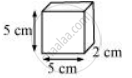
When these cuboids are arranged to form a cube, the side of this cube so formed will be a common multiple of the sides (i.e., 5, 2, and 5) of the given cuboid.
LCM of 5, 2, and 5 = 10
Let us try to make a cube with a 10 cm side.
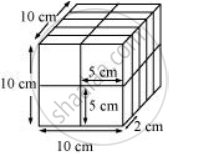
For this arrangement, we have to put 2 cuboids along with its length, 5 along with its width, and 2 along with its height.
Total cuboids required according to this arrangement: 2 × 5 × 2 = 20
With the help of 20 cuboids of such measures, a cube is formed as follows:
Alternatively
Volume of the cube on sides: 5cm, 2cm, 5cm
= 5cm × 2cm × 5cm = (5 × 5 × 2) cm3
Here, two 5s and one 2 are left that are not in a triplet.
If we multiply this expression by 2 × 2 × 5 = 20, then it will become a perfect cube.
Thus, (5 × 5 × 2 × 2 × 2 × 5) = (5 × 5 × 5 × 2 × 2 × 2) = 1000 is a perfect cube.
Hence, 20 cuboids of 5cm, 2cm, and 5cm are required to form a cube.
RELATED QUESTIONS
Find the cubes of the number 16 .
Write the cubes of 5 natural numbers of the form 3n + 2 (i.e. 5, 8, 11, ...) and verify the following:
'The cube of a natural number of the form 3n + 2 is a natural number of the same form i.e. when it is dividend by 3 the remainder is 2'.
By which smallest number must the following number be divided so that the quotient is a perfect cube?
7803
By which smallest number must the following number be divided so that the quotient is a perfect cube?
35721
Find the units digit of the cube root of the following number 13824 .
Find the least number by which 1323 must be multiplied so that the product is a perfect cube.
Find the cube-root of 9261.
Find the cube-root of -512
Find the cube-root of -2197.
Find the cube-root of - 15.625.
