Advertisements
Advertisements
प्रश्न
Parikshit makes a cuboid of plasticine of sides 5cm, 2cm, 5cm. How many such cuboids will he need to form a cube?
Advertisements
उत्तर
Here, some cuboids of size 5 × 2 × 5 are given.
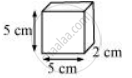
When these cuboids are arranged to form a cube, the side of this cube so formed will be a common multiple of the sides (i.e., 5, 2, and 5) of the given cuboid.
LCM of 5, 2, and 5 = 10
Let us try to make a cube with a 10 cm side.
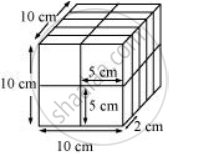
For this arrangement, we have to put 2 cuboids along with its length, 5 along with its width, and 2 along with its height.
Total cuboids required according to this arrangement: 2 × 5 × 2 = 20
With the help of 20 cuboids of such measures, a cube is formed as follows:
Alternatively
Volume of the cube on sides: 5cm, 2cm, 5cm
= 5cm × 2cm × 5cm = (5 × 5 × 2) cm3
Here, two 5s and one 2 are left that are not in a triplet.
If we multiply this expression by 2 × 2 × 5 = 20, then it will become a perfect cube.
Thus, (5 × 5 × 2 × 2 × 2 × 5) = (5 × 5 × 5 × 2 × 2 × 2) = 1000 is a perfect cube.
Hence, 20 cuboids of 5cm, 2cm, and 5cm are required to form a cube.
संबंधित प्रश्न
Find the smallest number by which the following number must be divided to obtain a perfect cube.
135
Write true (T) or false (F) for the following statement:
There is no perfect cube which ends in 4.
Write true (T) or false (F) for the following statement:
If a and b are integers such that a2 > b2, then a3 > b3.
Find the cube root of the following natural number 343 .
Find if the following number is a perfect cube?
1331
Find the cube-root of 64 x 729
Find the cube-root of -2744000
Find the cube-root of `− 27/343`
Find the cube-root of −175616
Find the smallest number by which 10985 should be divided so that the quotient is a perfect cube
