Advertisements
Advertisements
प्रश्न
Parikshit makes a cuboid of plasticine of sides 5cm, 2cm, 5cm. How many such cuboids will he need to form a cube?
Advertisements
उत्तर
Here, some cuboids of size 5 × 2 × 5 are given.
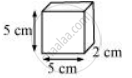
When these cuboids are arranged to form a cube, the side of this cube so formed will be a common multiple of the sides (i.e., 5, 2, and 5) of the given cuboid.
LCM of 5, 2, and 5 = 10
Let us try to make a cube with a 10 cm side.
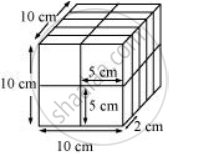
For this arrangement, we have to put 2 cuboids along with its length, 5 along with its width, and 2 along with its height.
Total cuboids required according to this arrangement: 2 × 5 × 2 = 20
With the help of 20 cuboids of such measures, a cube is formed as follows:
Alternatively
Volume of the cube on sides: 5cm, 2cm, 5cm
= 5cm × 2cm × 5cm = (5 × 5 × 2) cm3
Here, two 5s and one 2 are left that are not in a triplet.
If we multiply this expression by 2 × 2 × 5 = 20, then it will become a perfect cube.
Thus, (5 × 5 × 2 × 2 × 2 × 5) = (5 × 5 × 5 × 2 × 2 × 2) = 1000 is a perfect cube.
Hence, 20 cuboids of 5cm, 2cm, and 5cm are required to form a cube.
संबंधित प्रश्न
Find the smallest number by which the following number must be divided to obtain a perfect cube.
135
What is the smallest number by which the following number must be multiplied, so that the products is perfect cube?
7803
Write true (T) or false (F) for the following statement:
If a divides b, then a3 divides b3.
Write true (T) or false (F) for the following statement:
If a2 ends in 5, then a3 ends in 25.
Find the units digit of the cube root of the following number 571787 .
Find if the following number is a perfect cube?
1331
Find the cube-root of 64 x 729
Find the cube-root of −125 × 1000.
Show that 1944 is not a perfect cube
If a2 ends in 5, then a3 ends in 25.
