Advertisements
Advertisements
Question
Now rewrite the pair of sentences given below as one sentence.
I never thought of quitting. I knew what I wanted.
Advertisements
Solution
I never thought of quitting as I knew what I wanted.
RELATED QUESTIONS
Answer these question in one or two words or in short phrase.
Name five kinds of flutes.
Read the comic strip based on. H.G. Wells' novells.


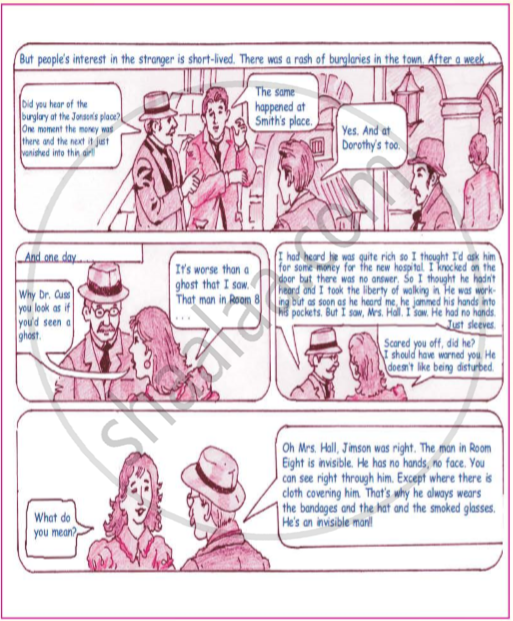
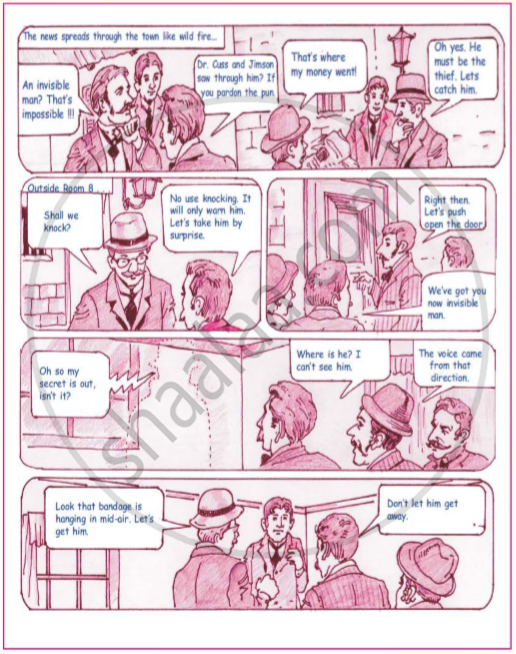
Answer the questions by ticking the correct option.
(a) The strange-looking man wanted ....
(i) the best room at the inn.
(ii} a room with a fire and a good lock.
(iii} a room with a good view.
(iv) a room where he could work quietly.
(b) Jimson was suspicious of the stranger because ...
(i} he did not answer Jimson's questions.
(ii} he did not want to talk about the weather.
(iii} he kept his back turned towards Jimson at all times.
(iv) he shouted atJimson when he entered his room.
(c) The people of the town gossiped about the stranger as ...
(i} he did not go out or talk to anyone in the town.
(ii} he had met with an accident and his face was bandaged.
(iii} he was new to the town and behaved rudely.
(iv) he stayed in his room and did not show his face to anyone.
(d) 'There was a rush of burglaries in the town. This means that ________
(i} there were many robberies in the town.
(ii) a few people in the town had seen a rob her.
(iii} the burglaries in the town were done in a rush.
(iv) the burglar was a rash and careless man.
(e) Although Jimson and Dr Cuss are suspicious of the strange guest, Mrs Hall tolerates him because ....
(i} she is not superstitious or ignorant.
(ii) she is sorry for the stranger who is bandaged.
(iii} the stranger is paying her a good amount of money for the room.
(iv} the stranger is polite and kind to Mrs Hall at all times.
(f) The stranger who was staying at the inn can be described as being ....
(I} violent
(ii} upright
(iii} dishonest
(iv) sensible
“If you are rested I would go,” I urged. “Get up and try to walk now.”
“Thank you,” he said and got to his feet, swayed from side to side and then sat down backwards in the dust.
“I was taking care of animals,” he said dully, but no longer to me. “I was only taking care of animals.”
There was nothing to do about him. It was Easter Sunday and the Fascists were advancing toward the Ebro. It was a grey overcast day with a low ceiling so their planes were not up. That and the fact that cats know how to look after themselves was all the good luck that the old man would ever have.
Read the extract given below and answer the question that follow.
Why could the Fascists planes not fly?
The village consisted of less than thirty houses, only one of them built with brick and cement. Painted a brilliant yellow and blue all over with gorgeous carvings of gods and gargoyles on its balustrade, it was known as the Big House. The other houses, distributed in four streets, were generally of bamboo thatch, straw, mud, and other unspecified material. Muni’s was the last house in the fourth street, beyond which stretched the fields. In his prosperous days Muni had owned a flock of forty sheep and goats and sallied forth every morning driving the flock to the highway a couple of miles away.
Read the extract given below and answer the question that follow.
What did Muni’s wife cook for him in the morning? How did she cook it?
“You haven’t brought home that sick brat!” Anger and astonishment were in the tones of Mrs. Joe Thompson; her face was in a flame.
“I think women’s hearts are sometimes very hard,” said Joe. Usually Joe Thompson got out of his wife’s way, or kept rigidly silent and non-combative when she fired up on any subject; it was with some surprise, therefore, that she now encountered a firmly-set countenance and a resolute pair of eyes.
“Women’s hearts are not half so hard as men’s!”
Joe saw, by a quick intuition, that his resolute bearing h«d impressed his wife and he answered quickly, and with real indignation, “Be that as it may, every woman at the funeral turned her eyes steadily from the sick child’s face, and when the cart went off with her dead mother, hurried away, and left her alone in that old hut, with the sun not an hour in the sky.”
“Where were John and Kate?” asked Mrs. Thompson.
“Farmer Jones tossed John into his wagon, and drove off. Katie went home with Mrs. Ellis; but nobody wanted the poor sick one. ‘Send her to the poorhouse,’ was the cry.”
“Why didn’t you let her go, then. What did you bring her here for?”
“She can’t walk to the poorhouse,” said Joe; “somebody’s arms must carry her, and mine are strong enough for that task.”
Read the extract given below and answer the question that follow.
What kind of person does Mrs Thompson appear to be?
Joe did not see the Guardians of the Poor on that day, on the next, nor on the day following. In fact, he never saw them at all on Maggie’s account, for in less than a week Mrs. Joe Thompson would as soon leave thought of taking up her own abode in the almshouse as sending Maggie there.
What light and blessing did that sick and helpless child bring to the home of Joe Thompson, the poor wheelwright! It had been dark, and cold, and miserable there for a long time just because his wife had nothing to love and care for out of herself, and so became soar, irritable, ill-tempered, and self-afflicting in the desolation of her woman’s nature. Now the sweetness of that sick child, looking ever to her in love, patience, and gratitude, was as honey to her soul, and she carried her in her heart as well as in her arms, a precious burden. As for Joe Thompson, there was not a man in all the neighbourhood who drank daily of a more precious wine of life than he. An angel had come into his house, disguised as a sick, helpless, and miserable child, and filled all its dreary chambers with the sunshine of love.
Read the extract given below and answer the question that follow.
What had changed Mrs Thompson?
Read the extract given below and answer the questions that follow:
There’s nobody on the house-tops now …..
Just a palsied few at the windows set;
For the best of the sight is, all allow,
At the Shambles’ Gate …… or, better yet,
By the very scaffold’s foot, I trow.
– The Patriot, Robert Browning
(i) Who is the speaker? Where is he being taken? Why?
(ii) Describe the scene when he had walked down the same street a year ago.
(iii) Where does the speaker think all the people had gathered that day? Why does he think so?
(iv) Describe the speaker's physical condition.
(v) What is the central message of the poem? Does the poem and on a note of hope or despair? Give one reason for your answer.
What changes had occurred, which forced people to live in underground homes?
Answer the following questions.
(i) If someone doesn’t wear a uniform to school, what do you think the teacher will say?
The cat was very happy to be on the ground. Pick out the phrase used to express this idea.
Multiple Choice Question:
A house becomes a home with ________
Multiple Choice Question:
Who is the poet of this poem?
Multiple Choice Question:
What is the significance of four o'clock?
In groups of four, discuss the following lines and their meanings.
But only words can free a thought
From its prison behind your eyes
Who is the speaker in the poem Whatif? What is she worried about? Can you suggest ways to get rid of silly fears?
Read aloud the two paragraphs that describe the boy and the old man at the Lucky Shop.
Complete the following sentence by providing a reason:
Towards the end of the story B. Wordsworth, the poet told the boy to never visit him because ______.
Complete the following sentence by providing a reason:
In the short story, To Build a Fire, the fire built by the man under the tree was extinguished because ______.
What suggestions were made in answer to the third question?
Do you agree with the view that Macbeth is fighting a lost battle against forces beyond his control? Justify your point of view in about 200- 250 words by referring to the Acts studied.
