Advertisements
Advertisements
Questions
Name the following:
Main ore of aluminium.
Name the ore for aluminium.
Give one word for the following:
An ore of aluminium.
Advertisements
Solution
Bauxite (Al2O3.nH2O) is the main ore of aluminium.
APPEARS IN
RELATED QUESTIONS
Name two metals which are found in nature in the free state.
Metallic oxides of zinc, magnesium and copper were heated with the following metals.
| Metal | Zinc | Magnesium | Copper |
| Zinc oxide | – | – | – |
| Magnesium oxide | – | – | – |
| Copper oxide | – | – | – |
In which cases will you find displacement reactions taking place?
Which of the following pairs will give displacement reactions?
Give two uses of bronze.
Which one of the methods given in column I is applied for the extraction of each of the metals given in column II:
| Column I | Column II |
| Electrolytic reduction | Aluminium |
| Reduction with Carbon | Zinc |
| Reduction with Aluminium | Sodium |
| Iron | |
| Manganese | |
| Tin |
Name one ore of sodium. Name the sodium compound present in this ore and write its chemical formula.
Name the metal which is extracted from haematite ore.
An important ore of zinc metal is ______.
During galvanisation, iron metal is given a thin coating of one of the following metals. This metal is:
A sulphide ore is converted into metal oxide by the process of ______.
When an object made of metal A is kept in air for a considerable time, it loses its shine and becomes almost black due to the formation of a layer of substance B. When an object made of another metal C is kept in damp air for a considerable time, it gets covered with a green layer of substance D. Metal A is the best conductor of electricity whereas metal C is the next best conductor of electricity.
- What is metal А?
- What is metal C?
- Name the substance B.
- Name the substance D.
- What type of chemical can be used to remove the green layer from metal C and clean it? Why?
Which metal can be extracted from the following ore?
Calamine
Give the principles of the hydrolytic method.
State why aluminium is extracted from its oxide by electrolysis while copper, lead, iron by reducing agents and mercury and silver by thermal decomposition.
Aluminum is used in thermite welding:
what is thermit?
Identify the process given in following passage and draw neat labelled diagram showing the process.
Electrolysis of molten mixture of alumina (melting point > 20000C) is done in a steel tank. The tank has a graphite lining on the inner side. This lining does the work of a cathode. A set of graphite rods dipped in the molten electrolyte works as anode. Cryolite (Na3AlF6) and fluorspar (CaF2) are added in the mixture to lower its melting point upto 10000C.
Give the chemical formula of :
Bauxite
Give the chemical formula of :
Sodium aluminate
Name the following:
Name two metals always find in combined state.
Define the term:
Slag
Which method of refining is used to get 99.8% pure aluminium?
Complete the incomplete statement with missing word:
Non-metals form acidic oxides while metals form ______.
Calcium, copper, lead, aluminium, zinc, chromium, magnesium, iron.
Choose the major metals from the list given above to make the following alloys:
(a) Stainless steel
(b) brass
Correct the following statement :
Copper reacts with nitric acid to produce nitrogen dioxide.
choose the most appropriate term to match the given description.
Heating of the ore in the absence of air to high temperature
Name the process used for the enrichment of sulphide ore.
Mercury, silver, gold are highly reactive metals.
Right or wrong sentence?
In the electrolytic dissipation method of alumina, the lining of graphite acts as an anode.
Gold and silver are active metals.
Explain the following reaction with the balanced equation.
Zinc sulphide is heated strongly in excess of air
Complete flow chart given below.
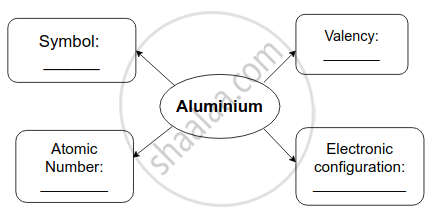
Explain Bayer’s process of concentration of bauxite with a chemical equation.
Explain in brief electrolytic reduction of alumina with a neat labelled diagram.
In thermite welding a mixture of ____________ is ignited with a burning magnesium ribbon which produces molten iron metal as a large amount of heat is evolved.
Which of the statements about the reaction, \[\ce{ZnO + CO -> Zn + CO2}\] is correct?
Which of the following ore is concentrated by the Froth floatation process?
Which of the following metals exist in their native state in nature?
- Cu
- Au
- Zn
- Ag
Assertion (A): The extraction of metals from their sulphide ores cannot take place without roasting the ore.
Reason (R): Roasting converts sulphide ores directly into metals.
A mineral from which the metal can be extracted economically and conveniently is known as ______.
