Advertisements
Advertisements
Question
Name the different kinds of inertia an object can possess. Give an example of each.
Advertisements
Solution
An object possesses two kinds of inertia, the inertia of rest and inertia of motion. A book lying on a table will remain placed at the table unless it is displaced by some external force. This is an example of inertia of rest.
A ball rolling on the ground will continue to roll unless the external force, the force of friction between the ball and the ground stops it.
APPEARS IN
RELATED QUESTIONS
Name the physical quantity whose unit is ‘newton’.
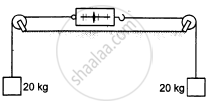
The figure shows a light spring balance connected to two blocks of mass 20 kg each. The graduations in the balance measure the tension in the spring. (a) What is the reading of the balance? (b) Will the reading change if the balance is heavy, say 2.0 kg? (c) What will happen if the spring is light but the blocks have unequal masses?
Consider a book lying on a table. The weight of the book and the normal force by the table in the book are equal in magnitude and opposite in direction. Is this an example of Newton's third law?
A block of 2 kg is suspended from a ceiling by a massless spring of spring constant k = 100 N/m. What is the elongation of the spring? If another 1 kg is added to the block, what would be the further elongation?
When a train starts, the head of a standing passenger seems to be pushed backward. Analyse the situation from the ground frame. Does it really go backward? Coming back to the train frame, how do you explain the backward movement of the head on the basis of Newton's laws?
State Newton's first law of motion.
Derive the relation between newton and dyne.
Give one example each of inertia of rest and inertia of motion.
Two blocks A and B of masses m and 2 m, respectively, are held at rest such that the spring is in natural length. Find out the accelerations of both the blocks just after release.

The masses of 10 kg and 20 kg, respectively, are connected by massless spring as shown in the figure. A force of 200 N acts on the 20 kg mass. At the instant shown, the 10 kg mass has acceleration of 12 m/s2. What is the acceleration of 20 kg mass?
(g = 10 m/s2)

