Advertisements
Advertisements
Question
Name the main nitrogenous waste in the human blood. How is it removed from the blood?
Advertisements
Solution
The main nitrogenous waste in the human blood is urea. The kidneys remove the urea from the blood and excrete them in the form of a dilute solution called urine.
Kidneys are the main excretory organ of the human body. There are millions of nephrons in each kidney. Each nephron contains a renal corpuscle and a renal tubule. The renal corpuscle consists of capillaries called the glomerulus, enclosed by a capsule called Bowman's capsule. The blood is filtered in the glomerulus and the filtrate travels through the renal tubules. Here, the materials needed by the body are reabsorbed, while the wastes (like urea) are collected and excreted in the urine.
APPEARS IN
RELATED QUESTIONS
The kidneys in human beings are a part of the system for ______.
the biological/technical terms for the hormone increasing reabsorption of water by kidney tubules
Write the functions of Ureter.
Differentiate between
tannins and resins
Answer the following in short.
List five waste products of plants.
Write down the functional activity of the following parts,
Henle's loop ………………
Define the following term :
Renal pelvis
Look at the figure given below. It is a section of human kidney as seen from the front.
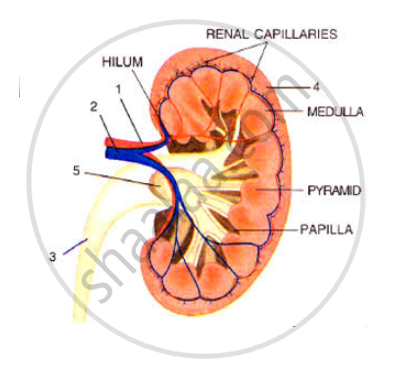
Which area/part (give its name and number given on the diagram) which contains the following:
(i) Malpighian capsule
(ii) The pyramids
(iii) Freshly collected urine
Study the diagram given alongside and then answer the question that follow:
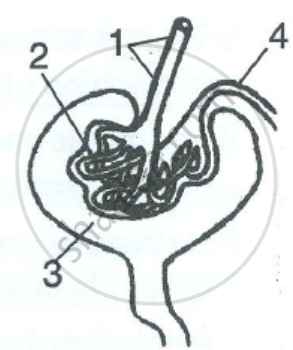
Name the parts labelled 1, 2, 3, and 4.
Complete the following sentence with appropriate word:
______ is the functional unit of kidney.
Complete the following sentence with appropriate word:
______ supplies blood to kidney.
State the Location: Renal pyramids
State the Location: Medulla of Kidney
Choose the correct option.
Which one of the following organisms excrete waste through nephridia?
Osmoregulation maintains the osmolarity of blood at about ______.
The mode of excretion of nitrogenous wastes like ammonia which takes place by simple diffusion is called ______.
The number of ATP molecules required to produce one molecule of urea from the omithine cycle.
“All plants give out oxygen during the day and carbon dioxide during the night”. Do you agree with this statement? Give a reason.
Identify the correct labels for A and B in the following diagram

