Advertisements
Advertisements
प्रश्न
Name the main nitrogenous waste in the human blood. How is it removed from the blood?
Advertisements
उत्तर
The main nitrogenous waste in the human blood is urea. The kidneys remove the urea from the blood and excrete them in the form of a dilute solution called urine.
Kidneys are the main excretory organ of the human body. There are millions of nephrons in each kidney. Each nephron contains a renal corpuscle and a renal tubule. The renal corpuscle consists of capillaries called the glomerulus, enclosed by a capsule called Bowman's capsule. The blood is filtered in the glomerulus and the filtrate travels through the renal tubules. Here, the materials needed by the body are reabsorbed, while the wastes (like urea) are collected and excreted in the urine.
APPEARS IN
संबंधित प्रश्न
the Biological/technical term Pigment providing colour to urine.
The Biological/technical term for The removal of nitrogenous wastes from the body
Name a waste gas released by the plants only during the night time.
What do kidneys excrete?
Write True (T) or False (F) for the following statement. Rewrite the false statement in the correct form.
Urine is devoid of blood cells.
Answer the following in short.
What is excretion?
Differentiate between the following pairs of terms:
Bowman’s capsule and malpighian capsule.
Fill in the blanks in the following passage to make it a meaningful description.
In a nephron, the ______ flows through the ______ under great pressure. The reason for this great pressure is that the ______ (outgoing) ______ is narrower than the ______ (incoming). This high pressure causes the ______ part of the blood to filter out from the ______ into the ______ capsule.
Name the following:
Functional unit of kidney.
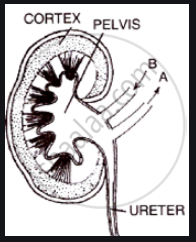
Given below is a highly simplified diagram of the human kidney cut open longitudinally. Answer the question that follow:
Name the functional units of the kidneys.
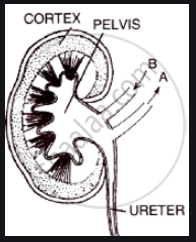
Given below is a highly simplified diagram of the human kidney cut open longitudinally. Answer the question that follow:
Write two differences in composition of the blood flowing through the blood vessels, 'A' and 'B'.
Study the diagram given alongside and then answer the question that follow:
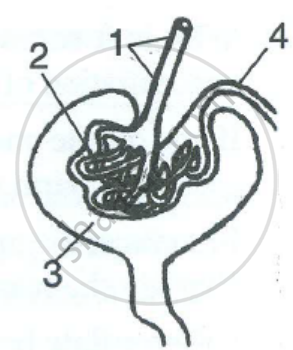
Name the stages involved in the formation of urine.
Answer the following question:
Explain the human excretory system with the help of a suitable diagram.
The diagram below represents a mammalian kidney tubule (nephron) and its blood supply. Parts indicated by the guidelines 1 to 8 are as follows:
1. U-shaped loop of Henle
2. Proximal convoluted tubule with blood capillaries
3. Bowman’s capsule
4. Afferent arteriole from the renal artery
5. Glomerulus
6. Venule to the renal vein
7. Collecting tubule
8. Distal convoluted tubule with blood capillaries Study the diagram and answer the following questions in each case:
(i) Where does ultrafiltration take place?
(ii) Which structure contains the lowest concentration of urea?
(iii) Which structure contains the highest concentration of urea?
(iv) Which structure contains the lowest concentration of glucose?
(v) Where is the most water reabsorbed?
Name the Following
The process by which kidneys regulate the water content of the body.
Write the functional activity of the following structure:
Glomerulus
Choose the correct option.
Visceral layer : Podocytes :: PCT : ________.
Choose the correct option.
Which one of the following organisms excrete waste through nephridia?
In a person the tubule part of the nephron is not functioning at all. What will its effect be on urine formation?
Give reason:
Excretion is a necessary process of our body.
