Advertisements
Advertisements
प्रश्न
Name the Following
The process by which kidneys regulate the water content of the body.
Advertisements
उत्तर
Osmoregulation
संबंधित प्रश्न
Why is it necessary to excrete waste products?
The diagram given alongside shows a section of a human kidney. Study the diagram carefully and answer the questions that follow:
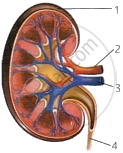
- Label the parts numbered 1 to 4.
- Why does part 2 have a striped appearance?
- What is the fluid that passes down part 4? Name the main nitrogenous waste present in it.
- Mention the structural and functional units of kidneys.
- Name the two major steps in the formation of the fluid mentioned in (c).
What is the function of excretory system in humans?
One of the following sets of body parts or substances or processed, pick out the one item which overall includes the remaining foir.
Skin, liver, lungs, kidneys, excretion.
Correct and rewrite the statement by changing the biological term that is underlined for the statement:
The kidney is composed of number of neurons.
The following diagram represents a mammalian kidney tubule (nephron) and its blood supply.
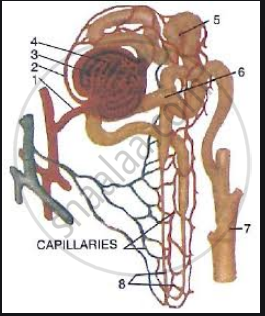
Parts indicated by the guidelines 1to 8 are as follows:
1. Afferent arteriole from renal artery
2. Efferent arteriole
3. Bowman's capsule
4. Glomerulus
5. Proximal convoluted tubule with blood capillaries
6. Distal convoluted tubule with blood capillaries
7. Collecting tubule
8. U-shaped loop of Henle
Study the diagram and answer the question that follow:
Which structure contains the lowest concentration of urea?
Explain the functioning of kidney.
Give Technical Term:
The tube joining the kidney to the urinary bladder.
Choose the correct option.
Deproteinised plasma is not found in ______.
The process of diffusion of solvent particles from the region of less solute concentration to a region of high solute concentration through a semi-permeable membrane is known as ____________.
