Advertisements
Advertisements
Question
Name important defence mechanisms in plants against herbivory.
Advertisements
Solution
Herbivores are plants’ natural predators. Plants have evolved many morphological and chemical defences against herbivory. Acacia and cactus depend on thorns as their primary defence mechanism. Certain plants have compounds that can make herbivores sick, delay digestion, disrupt reproduction, or even kill them.
APPEARS IN
RELATED QUESTIONS
Apart from being a part of the food chain, predators play other important roles. Mention any two such roles supported by examples.
Write what do phytophagous insects feed on.
Answer the following question.
Mention the term used to describe a population interaction between an orchid growing on a forest tree.
Give one example of interspecific competition.
What is the ecological process behind the biological control method of managing pest insects?
Define the following term:
Camouflage
Define community.
What is population ecology?
What is population interaction? Explain the interactions in Mutualism and Competition.
Match the following and choose the correct combination from the options given below.
| Column I | Column II |
| Mutualism | Lion and deer |
| Commensalism | Round worm and man |
| Parasitism | Birds compete with squirrels for nuts |
| Competition | Sea anemone on hermit crab |
| Predation | Barnacles attached to Whales |
Differentiate between predator and prey.
Using '-' to depict inhibition and '+' to depict benefit, mutualism between two species can be represented as ____________.
Which principle/theory states that 'Two closely related species competing for the same resources cannot co-exist indefinitely and the competitively inferior will be eliminated eventually.'?
Identify the interspecific interaction depicted in the following figure.
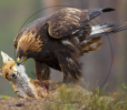
Which population interaction can be represented by'+''-'?
Which one of the following is an example of predation?
Which one of the following is NOT an example of commensalism?
A protozoan living in the digestive tract of a flea that lives on a dog is an example of ______
Exarch xylem is found in:
Define ectoparasite and endoparasite and give suitable examples.
In a pond, we see plants which are free-floating; rooted–submerged; rooted emergent; rooted with floating leaves; Write the type of plant against the following examples.
| Plant Name | Type | |
| a. | Hydrilla | ______ |
| b. | Typha | ______ |
| c. | Nymphaea | ______ |
| d. | Lemna | ______ |
| e. | Vallisneria | ______ |
Observe the set of 4 figures A, B, C and D and, answer the following questions
- Which one of the figures shows mutualism?
- What kind of association is shown in D?
- Name the organisms and the association in C.
- What role is the insect performing in B?
 Fig. (A) |
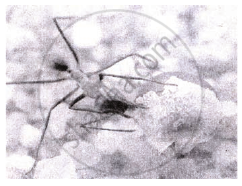 Fig. (B) |
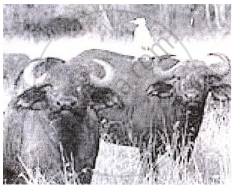 Fig. (C) |
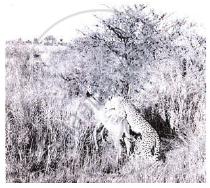 Fig. (D) |
Match the Column I with Column II.
| Column I | Column II |
| A. Lichen | (i) Commensalism |
| B. Shark and Pilot fish | (ii) Mutualism |
| C. Barnacles on the back of a whale | (iii) Symbiotic obligatory relationship |
| D. Sharks and dolphins | (iv) Competition |
Observe the graph given below.
|
The graph represents inter-specific interaction between two species of Paramecia competing for the same resource in a culture medium. Paramecium caudatum and Paramecium aurelia were grown in separate cultures as well as in mixed cultures. It was found that each species grew in numbers according to the logistic equation.
|

a) Which species is competitively superior? Support it with the data provided in the graph.
b) State the underlying principle for the above result and name the scientist associated with this principle.
c) Explain the mechanism in which two or more species competing with each other can co-exist.
OR
Graphs A and B shown below depict interaction of two species. Which graph indicates Mutualism? Give reason.
 |
 |
| A | B |
Some orchids live on the branches of mango trees. Name the type of interaction that exists between the mango tree and the orchid.
What happens to an inferior competitor if a superior competitor is present in the same environment?
What happens to an inferior competitor if the superior competitor is removed from the environment?
Give one example of commensalism.
What is the sign convention for commensalism?
