Advertisements
Advertisements
Question
Match the following.
| Column A | Column B |
| 1. Rolling friction | a. making grooved designs |
| 2. Static friction | b. regular oiling |
| 3. Reducing friction | c. a book placed on a tabletop |
| 4. Increasing Friction | d. wheels of a car |
Advertisements
Solution
| Column A | Column B |
| 1. Rolling friction | d. wheels of a car |
| 2. Static friction | c. a book placed on a tabletop |
| 3. Reducing friction | b. regular oiling |
| 4. Increasing Friction | a. making grooved designs |
APPEARS IN
RELATED QUESTIONS
To draw water from a well we have to ______ at the rope.
To move a loaded trolley we have to ______ it.
In the following situation identify the agent exerting the force and the object on which it acts. State the effect of the force in case.
A load suspended from a spring while its other end is on a hook fixed to a wall.
Select the correct alternative.
A body falls downwards because of
Select the correct alternative.
Friction is increased if
Name the term used for the push or pull?
State the effect produced by a force in the following case:
A man pushes a heavy cart
What do you mean by the gravitational force? Give an example to illustrate it.
Match the following.
| Column A | Column B |
| 1. Non-contact forces | a. perpendicular to surface |
| 2. Catapult | b. an act of push or pull |
| 3. Force | c. unit of force |
| 4. Normal force | d. action-at-a-distance forces |
| 5. Newton | e. contact force |
Can you identify whether it is push or pull that results in motion in the following cases?
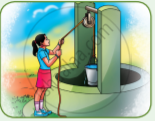 |
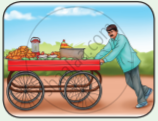 |
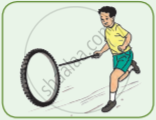 |
| Push / Pull | Push / Pull | Push / Pull |
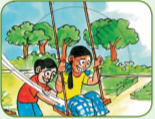 |
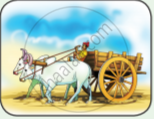 |
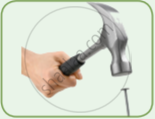 |
| Push / Pull | Push / Pull | Push / Pull |
