Advertisements
Advertisements
Question
Answer the following in detail.
Differentiate between contract and non-contract force. Support your answer with suitable examples.
Advertisements
Solution
| Contract force | Non-contact force | ||
| i) | These are forces that need a physical touch on the object to act upon it. | i) | These are forces that do not need physical contact to act on an object. |
| ii) | These may or may not be natural forces. | ii) | These are natural forces. |
| iii) | They cannot work from a distance. | iii) | They can work from a distance as well. |
| iv) | Its various types are applied to force, normal force, tension, frictional force. | iv) | Its various types are magnetic force, electrostatic force, gravitational force. |
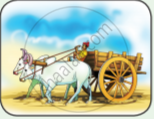
| v) | Example: Player kicking a ball, game of tug-of-war, rolling ball stops, itself, horse pulling a cart, etc. | v) | Example: Magnet attracting iron nails, mango falling from a tree, charged plastic ruler attracts bits of dry-paper, etc. |
APPEARS IN
RELATED QUESTIONS
An archer stretches her bow while taking aim at the target. She then releases the arrow, which begins to move towards the target. Based on this information fill up the gap in the following statement using the following terms.
While the arrow moves towards its target, the forces acting on it are due to ______ and that due to ______ of air.
In the following situation identify the agent exerting the force and the object on which it acts. State the effect of the force in case.
A load suspended from a spring while its other end is on a hook fixed to a wall.
Select the correct alternative.
A body falls downwards because of
Select the correct alternative.
Friction is increased if
What do you mean by the gravitational force? Give an example to illustrate it.
Match the following.
| Column A | Column B |
| 1. Non-contact forces | a. perpendicular to surface |
| 2. Catapult | b. an act of push or pull |
| 3. Force | c. unit of force |
| 4. Normal force | d. action-at-a-distance forces |
| 5. Newton | e. contact force |
State if the following statement is true or false. Correct the statement if it is false.
It is possible that a force applied to an object may not bring any change in it.
State if the following statement is true or false. Correct the statement if it is false.
Two equal and opposite forces acting on an object balance out each other.
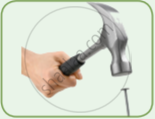
Can you identify whether it is push or pull that results in motion in the following cases?
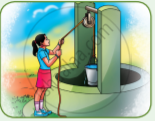 |
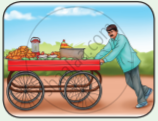 |
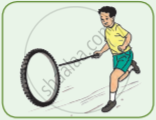 |
| Push / Pull | Push / Pull | Push / Pull |
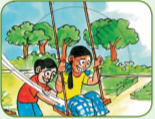 |
 |
 |
| Push / Pull | Push / Pull | Push / Pull |
______ is an ancient Indian astronomer.
