Advertisements
Advertisements
Question
| Malu Bhalu | True or False | Character Sketch |
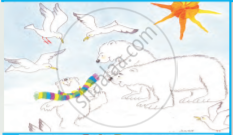 |
Malu’s hair was white. | brave, strong, hardworking, eager to learn more, smart, caring, impatient, female, affectionate, bold, playful, white, adventurous, clever, young, fearless |
 |
Malu knew how to swim. | |
 |
Malu was playing with the penguins. | |
 |
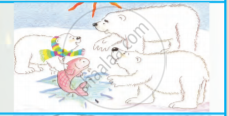
Malu was good at catching fish. | |
 |
Malu was a brave bhalu. | |
| Malu did not love her mother. | ||
| Malu’s mother was firm. |
Now write a detailed character sketch of Malu Bhalu.
Advertisements
Solution
| Malu Bhalu | True or False | Character Sketch |
|
Malu’s hair was white. - True | brave, strong, hardworking, eager to learn more, smart, caring, impatient, female, affectionate, bold, playful, white, adventurous, clever, young, fearless |
|
Malu knew how to swim- False. | 1. Malu bhalu was brave. |
|
Malu was playing with the penguins- False. | 2. She was strong and hard-working. |
|
Malu was good at catching fish- True. | She was eager to learn more. |
|
Malu was a brave bhalu- True. | She was affectionate. |
| Malu did not love her mother- False. | She was bold, fearless, and adventurous | |
| Malu’s mother was firm- True. |
Malu Bhalu was a female polar bear. She was young and playful. She was covered with white hair. She was very clever and soon learned how to fish. She was eager to learn the art of swimming. She was so smart that she learned this art too quickly. She was bold and fearless. She was adventurous too.
APPEARS IN
RELATED QUESTIONS
Who feels joyful on seeing the Ice-cream Man?
What is the ice-cream cart compared to in the poem?
Colour the boxes that have rhyming words.
| city cart |
heat street |
blows goes |
do go |
| hard yard |
bowl doll |
cow so |
label table |
| sky my |
play obey |
race fafe |
write night |
Complete the following sentence.
In a relay race, if no one passes the baton, then ______.
Name the team members needed for the following.
To run a restaurant we need.
Complete the sets of rhyming words. One has been done for you.
| Words from the poem | team | plus | done | hoop | shoot | goal | joy |
| Your own words | beam |
What time of the day do you think it is when your shadow is the tallest? Why?
- Morning
- Afternoon
- Night.
Read the lines from the poem and answer the following.
He is very very like me.
From the heels up to the head!
- Who does he refer to?
- Who does me refer to?
- Why are he and me alike?
Do the actions as given below, and observe which part, or fingers, of your hand, is being used.
| point at a door | bounce a ball | scratch your chin |
| twist your ear | comb your hair | draw with a pencil |
| touch a flower |
Where is the child ________ parents have come to school?
| shoe | shadow | fish | bush |
| ship | sheep | dish | wash |
| shell | shade | wish | brush |
Read the first two lines of the poem. Is the mood.
In the last few lines, the mood of the poet has changed. What is it now?
The poet says that you should open the window and show people that you are crying.
Fill in the blank with the exact feeling word.
The tourists were ________ to see the beautiful Taj Mahal.
When a lady frog hops by, he does not even ______.
When do children go to school in Topsy-turvy Land?
Did the boy share his toffee and tricycle with others?
Where did the polar bear live with her family?
