Advertisements
Advertisements
Question
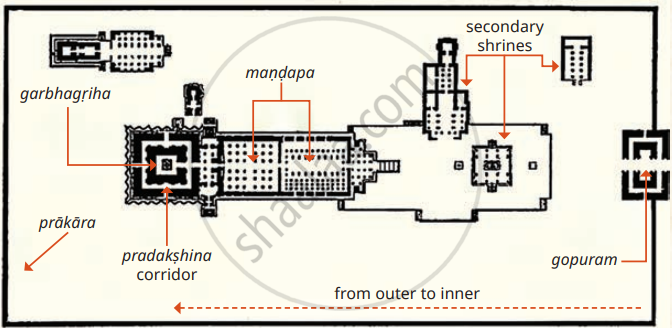
Looking at Fig., can you work out the horizontal equivalence between a temple and the cosmic being?
Very Long Answer
Advertisements
Solution
Yes, the horizontal plan of the temple can be understood as a representation of the cosmic being, Purusha. The different parts of the temple correspond to different parts of the cosmic body.
- Gopuram – Feet/Lower Body: The gopuram, shown at the entrance of the temple, represents the feet or lower part of Purusha. It marks the beginning of the journey into the temple.
- Mandapa – Torso: The mandapas, or pillared halls, represent the torso or middle part of the body. They form the main connecting spaces between the entrance and the inner sanctum.
- Pradakshina Corridor – Journey: The pradakshina corridor allows devotees to move around the sacred centre. This movement represents the spiritual journey towards the divine.
- Garbhagriha – Head/Heart: The garbhagriha, or innermost sanctum, represents the head or heart of Purusha. It is the most sacred part of the temple, where the main deity is placed.
- Outer to Inner Movement: As shown in the diagram, the movement from the gopuram (outer entrance) towards the garbhagriha (inner sanctum) symbolises a journey from the material and outer world towards the inner divine reality.
shaalaa.com
Is there an error in this question or solution?
