Advertisements
Advertisements
Question
Listen to the poem and fill in the blanks with appropriate words and phrases. If required, listen to the poem again
Wander-thirst
BEYOND the East the sunrise, beyond the West the sea, And East and West the wander-thirst that will not let me be; It works in me like madness, dear, to bid me say good-bye; For the seas call, and the stars call, and oh! the call of the sky!
I know not where the white road runs, nor what the blue hills are; But a man can have the sun for a friend, and for his guide a star; And there’s no end of voyaging when once the voice is heard, For the rivers call, and the roads call, and oh! the call of the bird!
Yonder the long horizon lies, and there by night and day The old ships draw to home again, the young ships sail away; And come I may, but go I must, and, if men ask you why, You may put the blame on the stars and the sun and the white road and the sky.
Choose the best option and complete the sentences.
1. ______ works like madness in the poet.
- Wander – Thirst
- Bidding Farewell
- Eastern Sunrise
- Western Seas
2. A man could choose ______ as his guide.
- the sun
- the hills
- a star
- a bird
3. There is no end of ______once the voice is heard.
- walking
- roaming
- talking
- voyaging
4. The old ships return, while the young ships ______.
- drift
- move
- sail
- wander
5. The blame is on the sun, stars, the road and the ______.
- hills
- trees
- seas
- sky
Advertisements
Solution
- Wander – Thirst works like madness in the poet.
- A man could choose a star as his guide.
- There is no end of voyaging once the voice is heard.
- The old ships return, while the young ships sail.
- The blame is on the sun, stars, the road and the sky.
APPEARS IN
RELATED QUESTIONS
Listen carefully and write all the words correctly.
Do you know the tale of the mouse who had seven tails?
Please tell it to us.
As the sky was cloudy, they could get the glimpse of the Mount Everest.
The dream of Severn Suzuki is ______.
Aadhav and Raghav are ______.
A strong foundation for any individual comes from being with a __________.
Preethi Srinivasan was not only a cricketer but also a runner.
List of __________ trains will appear.
What happened?
What do strong winds and gales carry?
There’s a calculator in her mobile.
"And the robber definitely did not use the front door." Which is the best way to rewrite this sentence?
What does the detective seem to think will happen if he solves the mystery?
Painting can help unleash your creative side. How?
Listen to the passage carefully and write the answer.
Fleming’s thought at breakfast
Sir Alexander Fleming, who discovered penicillin, was once forced into an interview in New York by two journalists just as he was about to have breakfast. One of them asked him, ‘Sir, what are you thinking about right now? We wish to know what a great scientist think while getting ready for breakfast’. Fleming mused a while on the question and he replied, ‘I am thinking of something very special. The journalist, who were all ears, drew themselves forward. ‘I am thinking, whether to have one egg or two.
- Name the scientist.
- What did he discover?
- Who approached the scientist?
- What was the question asked by the journalist?
- When did they meet the scientist?
The daughter is going to cook the fish.
The speaker is most probably a.
One pound is equal to______.
Who bagged 'all-rounder' award?
Choose the correct one after listening to the announcement.
The Kovai Superfast Express is arriving on platform no. ______.
The Thirukkural Superfast Express is late by ______.
Choose the correct one after listening the movie clip.
The can opener is in the second door from the right.
Listen to the conversation and answer the following.
What type of coffee did the customer order?
- instant
- black
- filter
She hold her mom's hand very tight.
Listen to the advertisement and answer the question given.
The minimum deposit for an account is ______.
- Public Provident Fund
- Selvamagal
- Postal Life Insurance
Listen to the following paragraph.
|
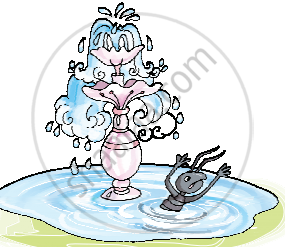
The Ant and the Dove On his way home, an ant saw a sparkling fountain. He crawled onto its wall to take a closer look.
Suddenly he slipped and fell into the water. He gurgled and panicked and waved his legs in the air. “Help! I can't swim,” he cried. Luckily, just at that moment, a friendly dove flew by. She saw that the tiny ant was drowning and quickly flew to a nearby tree. She pulled off a leaf and let it glide down to the ant. “Here you are,” she cooed and flew away.
(Adapted from Aesop’s Fables) |

- Why do you think the dove helped the ant?
- How do you think the ant felt on finding the leaf?
- Have you ever been in trouble like the ant? Did anyone help you?
Listen to the audio and choose true or false.
You can’t hold the pencil hard.
First, read the following statements. Then, listen to the passage read aloud by your teacher or played on the recorder and answer the questions that follow. You may listen to it again, if required.
Tejaswini Sawant is an Indian shooter from the Maharashtrian city of Kolhapur. Her father Ravinder Sawant was an officer in the Indian Navy. Tejaswini represented India in 2004 at the 9th South Asian Sports Federation Games. She, in the 2006 Commonwealth Games, won one gold medal in Women’s 10m Air Rifle Singles and Women’s 10m Air Rifle Pairs. In 2009, in the 50m Rifle 3 positions, she won a bronze and in 2010 she became a world champion in the 50m Rifle Prone game held in Germany. In the 2010 Commonwealth Games, she won one bronze and two silver medals in the women’s 50m Rifle Prone Pairs, the Women’s 50m Rifle Prone Singles and the Women’s 50m Rifle 3 positions respectively. Tejaswini was the first Indian shooter to win a Gold medal at the world championship in the 50m Rifle Prone Game.
Choose the most appropriate option and complete the sentences.
1. Tejaswini Sawant is an Indian______.
- shooter
- boxer
- cricketer
2. She represented India at the 9th South Asian Sports Federation Games in ______.
- 2001
- 2002
- 2004
3. In 2006, she won a Gold medal in the ______.
- Commonwealth Games
- Olympic Games
- Asian Games
4. She became a world champion in the 50m Rifle Prone game held in ______.
- Germany
- Russia
- India
5. Tejaswini was the first Indian woman shooter to win a ______ medal at the World Championship in the 50m rifle prone game.
- gold
- silver
- bronze
Listen to the information about Vishalini and complete her profile with suitable words/phrases.
Vishalini, hailing from ______in Tamilnadu is ______years old. She is endowed with an outstanding ______and ______skills. Her IQ is ______, higher than the previous score of ______. She has been the ______speaker in International conferences. At the Google India Summit, she was honoured as the youngest ______. She is the recipient of ______international awards. This child prodigy is considered a ______girl.
Now, you are going to listen to the cautionary instructions that are given to the general public living in flood-prone areas. Listen carefully and complete the following sentences.
Floods are an inevitable natural disaster that can occur in any part of the world. Floods can prove all the more disastrous in localities, where population density is high. Preparation for Disaster Management has become imperative for any city, town, or village during monsoons. The Government Department entrusted with Disaster Management makes periodic announcements about the precautions to be taken whenever floods are anticipated.
Now, you are going to listen to the cautionary instructions that are given to the general public living in flood-prone areas. Listen carefully and complete the following sentences. For the attention of the public, here is an announcement from the Department of Disaster Management. As per the warning issued today by the Meteorological Department, there exists a high probability of a widespread heavy downpour from the early hours of Sunday and consequent flooding of low-lying areas. In order to ensure the safety of life and property, everyone is hereby warned and advised to take certain precautionary measures:
- First of all, prepare a household flood plan and be ready to respond to the situation.
- Find out the locations of the closest flood shelters available and routes to reach them.
- Maintain an emergency kit comprising water bottles, biscuit packets, medical supplies, a torchlight, and a whistle to signal for help.
- Paste or fix a list of emergency telephone numbers on the wall in a visible spot.
- Switch off hazardous items like gas cylinders and disconnect electrical gadgets.
- Secure important personal documents and valuables in a waterproof case and place it in an accessible location.
- Place small pieces of furniture and clothing on tables and cots.
- Shift all the small objects safely to the loft.
- Empty your refrigerators and leave their doors open to avoid damage in case they float.
- Charge your mobile phones as well as your battery banks so as to communicate with friends, relatives, and emergency services.
- Place sandbags in the toilet bowls and bathroom drain holes to prevent sewage inflow.
- Prepare and pack food with a long shelf life.
- Finally, listen to the periodic news updates through your portable communication devices and follow the instructions implicitly.
- The announcement was made by the Department of ______.
- Widespread heavy rains are expected from the early hours of ______.
- The public is asked to find out the locations of ______.
- An emergency kit should contain water bottles, biscuit packets, and a ______.
- A list of ______should be displayed on the wall. f) Important documents can be secured by keeping them in a______ case.
- Damage to refrigerators can be avoided by ______.
- Mobile phones should be charged to enable the marooned to contact their friends, relatives and ______.
- ______should be placed in the toilet bowls to prevent sewage inflow.
- Listen to the ______and follow the instructions implicitly.
