Advertisements
Advertisements
Question
Listen to the following paragraph.
|
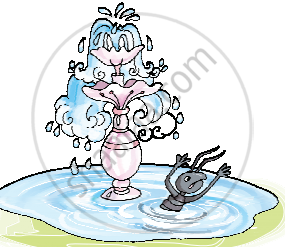
The Ant and the Dove On his way home, an ant saw a sparkling fountain. He crawled onto its wall to take a closer look.
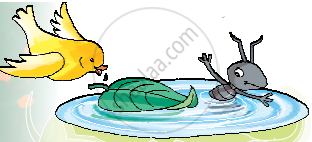
Suddenly he slipped and fell into the water. He gurgled and panicked and waved his legs in the air. “Help! I can't swim,” he cried. Luckily, just at that moment, a friendly dove flew by. She saw that the tiny ant was drowning and quickly flew to a nearby tree. She pulled off a leaf and let it glide down to the ant. “Here you are,” she cooed and flew away.
(Adapted from Aesop’s Fables) |
- Why do you think the dove helped the ant?
- How do you think the ant felt on finding the leaf?
- Have you ever been in trouble like the ant? Did anyone help you?
Advertisements
Solution
- I think the dove helped the ant because she was friendly by nature and so took pity on the tiny ant.
- On finding the leaf the ant would have felt very happy. She would have also felt thankful to the dove.
- Once I got lost in a fair. I got panicked. I requested several persons, to give me their mobile for a while so that I may call to my father. But no one helped me. In the last I went to a policeman and gave him my father’s mobile number. The policeman contacted with my father and told him to pick me up from the main gate of the compound where the fair was held.
APPEARS IN
RELATED QUESTIONS
The Paralympic games usually happen ______.
The brothers are planning to celebrate their ___________ wedding anniversary.
After filling information and captcha click on __________ booking.
What time of the day did it happen?
She usually listens to music on her mobile.
Near the beginning of the story, “Ms. Gervis’ eyes are full of tears. Her hands are shaking.” How does Ms. Gervis probably feel?
What does the detective seem to think will happen if he solves the mystery?
Madhubani paintings were originally done on ______.
This painting has international recognition.
The speaker is most probably a.
The truck went over a stone.
Nandhu wanted to play with the lamp.
Mint leaves help to cure______.
Whose speech is this?
Teacher smiles at Rani.
Listen to the advertisement and answer the question given.
The minimum deposit for an account is ______.
- Public Provident Fund
- Selvamagal
- Postal Life Insurance
Listen to the advertisement and answer the question given.
The name of the savings scheme is ______.
- ₹ 1000
- ₹ 2000
- ₹ 500
Listen to the sounds around you.
Read the following statements. Now, listen to the talk on the importance of humour and laughter for good physical and mental health. You may listen to the text again if required, to help you choose the correct option
Humour and laughter are used in a variety of therapeutic situations. Therapeutic humour has the power to motivate and lessen stress and pain. Laughter improves one’s sense of well being. The benefits of a good “belly laugh” are being discovered by empirical research. You can feel relaxed and good after laughing at a funny movie, television program, or humorous event.
It seems generally accepted that our bodies respond in a positive way to a hearty laugh. It is reported that laughter, like exercise, can reduce stress, improve tolerance to pain, and alter bodily functions such as blood pressure, heart rate, muscle activity, and stomach acidity. In business, managers are learning the advantages of using humour. Happier, healthier employees work better. Humour improves employee creativity, so employees are sometimes trained how to introduce humour into their personal/professional life.
A number of hospitals and related institutions have created humour rooms. The humour room is stocked with books, comics, funny posters, audiotapes, and videos. Humour is a therapeutic tool that demands energy for its creation, yet its rich rewards include a closer therapeutic bond through shared laughter. The best humour comes from what is going on “at the moment.” Therefore one can plan to use humour yet rely on spontaneous opportunities to employ it. Humour is something positive that should bring mutually shared enjoyment and pleasure. Above all, humour is called a way of living not a part of living.
i) Humour has the power to motivate and ______stress and pain.
- improve
- intensify
- intensify
- increase
ii) It seems generally ______that our bodies respond in a positive way to a hearty laugh.
- accepted
- denied
- improved
- confused
iii) The _________ is stocked with books, comics, funny posters, audiotapes, and videos.
- waiting room
- humour room
- ICU
- reception
iv) One can plan to use humour yet rely on __________ opportunities to employ it.
- late
- better
- future
- spontaneous
v) Humour is called a way of _________, not a part of living.
- living
- playing
- nourishing
- developing
First, read the following statements. Then, listen to the passage read aloud by your teacher or played on the recorder and complete the statements. You may listen to it again, if required.
There are many answers to this question. Firstly, 1 would say that we owed much to the work of previous climbers on Everest: to the experience and know ledge they passed on, and to the fact that they had gone on trying and had never given up hope.
Next, I w ould place the careful and thorough planning done before the climb began. On the Everest, a large number of people have to do different things in different places at the same time. Unless every detail had been worked out in advance, things would quickly have gone wrong.
The third reason was the excellence of our equipment. In particular, our oxygen apparatus was very important, and it worked well. Without it. we could not have reached the summit.
Our own fitness played a big part in the climb, and this was due to our periods of training, in which we got used gradually to great heights: and to our food; and to the care and attention we received from our doctors.
Above all else, I should like to mention how well we worked together. That was the biggest single reason why we got to the top. In the four months we were together we lived and worked as a team. Not everyone could climb to the top. Some of the members had jobs to do on other parts of the mountain; jobs that were less exciting than climbing to the summit, but just as dangerous and uncomfortable. But everyone played his part to the full. That was the biggest thing of all.
In the same way, our Sherpas were magnificent. Without our tents, our oxygen, our food, our climbing gear, the summit could not have been reached. And without the Sherpas, we could
not have lifted all this equipment, which weighed 750 lb., up to 26,000 feet, ready for the assaults. No praise is too high for these cheerful and
gallant men.
Finally, there was the weather. For five weeks we had bad weather; then, after the middle of May, we were lucky. It no longer snowed, and even the wind sometimes dropped.
Complete the following.
a) List any three aspects which contributed to the success of the ascent of the summit.
- ______
- ______
- ______
b) Without the help of ______nothing would have been possible.
c) The main idea of the passage is ______.
d) The biggest thing of all is ______.
e) ______were cheerful and gallant men.