Advertisements
Advertisements
Question
List various types of isomerism possible for coordination compounds, giving an example of each.
Advertisements
Solution
(i) Geometric isomerism: This type of isomerism is common in heteroleptic complexes. It arises due to the different possible geometric arrangements of the ligands. For example:
\[\begin{array}{cc}
\phantom{..}\ce{Cl}\phantom{.....}\ce{NH3}\phantom{}\\
\backslash\phantom{...}/\\
\ce{Pt}\\
/\phantom{...}\backslash\\
\ce{\underset{cis}{\phantom{..}Cl\phantom{.....}NH3}}
\end{array}\]
\[\begin{array}{cc}
\phantom{..}\ce{Cl}\phantom{.....}\ce{NH3}\phantom{}\\
\phantom{}\backslash\phantom{...}/\\
\ce{Pt}\\
/\phantom{...}\backslash\phantom{}\\
\ce{\underset{trans}{NH3\phantom{....}Cl\phantom{..}}}
\end{array}\]
(ii) Optical isomerism: This type of isomerism arises in chiral molecules. Isomers are mirror images of each other and are non-superimposable.
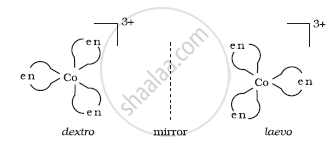
(iii) Linkage isomerism: This type of isomerism is found in complexes that contain ambidentate ligands. For example, [Co(NH3)5(NO2)]Cl2, which is obtained as a red form and [Co(NH3)5(ONO)]Cl2 obtained as a yellow form.
(iv) Coordination isomerism: This type of isomerism arises when the ligands are interchanged between cationic and anionic entities of different metal ions present in the complex. For example, [Co(NH3)6] [Cr(CN)6] and [Cr(NH3)6] [Co(CN)6].
(v) Ionization isomerism: This type of isomerism arises when a counter ion replaces a ligand within the coordination sphere. Thus, complexes that have the same composition but furnish different ions when dissolved in water are called ionization isomers. For example, [Co(NH3)5(SO4)]Br and [Co(NH3)5Br]SO4.
(vi) Solvate isomerism: Solvate isomers differ by whether or not the solvent molecule is directly bonded to the metal ion or merely present as a free solvent molecule in the crystal lattice. For example, [Cr(H2O)6]Cl3 (violet) and [Cr(H2O)5Cl]Cl2.H2O (grey-green).
APPEARS IN
RELATED QUESTIONS
Answer the following question.
Draw geometric isomers and enantiomers of the following complex.
[Pt(en)3]4⊕
Answer the following question.
Draw geometric isomers and enantiomers of the following complex.
[Pt(en)2ClBr]2⊕
Draw optical isomers of [Co(en)3]3+.
Which type of isomerism is exhibited by [Pt(NH3)2Cl2]?
Draw all possible geometrical isomers of the complex \[\ce{[Co(en)2Cl2]^+}\] and identify the optically active isomer.
The term anomers of glucose refer to ____________.
Which would exhibit coordination isomerism?
Which of the following is NOT a pair of structural isomers?
How many isomers are possible for an alkane having molecular formula C5H12?
The number of geometrical isomers of [CrCl2(en)2]+ is ____________.
Geometrical isomerism is not shown by
Draw geometric isomers of the following complex.
Geometrical isomers of Pt(NH3)2Cl2
Give cis isomer of [Co(NH3)4Cl2]⊕.
Indicate the type of isomerism exhibited by the following complex and draw the structures for this isomer:
\[\ce{[Pt(NH3)(H2O)Cl2]}\]
Explain the ionisation isomers.
The co-ordination number of Co3+ ion in the complex [Co(NH3)4Cl2]⊕ is ______.
Which one of the following complex ions has geometrical isomers?
Three organic compounds A, B and C are non cyclic functional isomers of carbonyl compounds with molecular formula C4H8O. Isomers A and C give positive Tollen’s test while compound B does not give positive Tollen’s test but gives positive iodoform test. Compounds A and B on reduction with Zn amalgam and conc. HCl give the same product.
- Write the structures of the compounds A, B and C.
- Out of the compounds A, B and C, which one will be the least reactive towards addition of HCN.
