Advertisements
Advertisements
प्रश्न
List various types of isomerism possible for coordination compounds, giving an example of each.
Advertisements
उत्तर
(i) Geometric isomerism: This type of isomerism is common in heteroleptic complexes. It arises due to the different possible geometric arrangements of the ligands. For example:
\[\begin{array}{cc}
\phantom{..}\ce{Cl}\phantom{.....}\ce{NH3}\phantom{}\\
\backslash\phantom{...}/\\
\ce{Pt}\\
/\phantom{...}\backslash\\
\ce{\underset{cis}{\phantom{..}Cl\phantom{.....}NH3}}
\end{array}\]
\[\begin{array}{cc}
\phantom{..}\ce{Cl}\phantom{.....}\ce{NH3}\phantom{}\\
\phantom{}\backslash\phantom{...}/\\
\ce{Pt}\\
/\phantom{...}\backslash\phantom{}\\
\ce{\underset{trans}{NH3\phantom{....}Cl\phantom{..}}}
\end{array}\]
(ii) Optical isomerism: This type of isomerism arises in chiral molecules. Isomers are mirror images of each other and are non-superimposable.
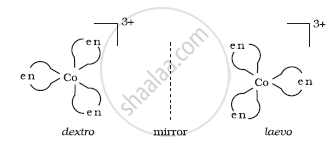
(iii) Linkage isomerism: This type of isomerism is found in complexes that contain ambidentate ligands. For example, [Co(NH3)5(NO2)]Cl2, which is obtained as a red form and [Co(NH3)5(ONO)]Cl2 obtained as a yellow form.
(iv) Coordination isomerism: This type of isomerism arises when the ligands are interchanged between cationic and anionic entities of different metal ions present in the complex. For example, [Co(NH3)6] [Cr(CN)6] and [Cr(NH3)6] [Co(CN)6].
(v) Ionization isomerism: This type of isomerism arises when a counter ion replaces a ligand within the coordination sphere. Thus, complexes that have the same composition but furnish different ions when dissolved in water are called ionization isomers. For example, [Co(NH3)5(SO4)]Br and [Co(NH3)5Br]SO4.
(vi) Solvate isomerism: Solvate isomers differ by whether or not the solvent molecule is directly bonded to the metal ion or merely present as a free solvent molecule in the crystal lattice. For example, [Cr(H2O)6]Cl3 (violet) and [Cr(H2O)5Cl]Cl2.H2O (grey-green).
APPEARS IN
संबंधित प्रश्न
Out of  and
and  , which one is optically active and why ?
Answer the following in one or two sentences.
Consider the complexes \[\ce{[Cu(NH3)4][PtCl4] and [Pt(NH3)4] [CuCl4]}\]. What type of isomerism these two complexes exhibit?
Answer in brief.
What are ionization isomers ? Give an example.
Which one of the following complexes is not expected to exhibit isomerism?
Fac-mer isomerism is shown by
Which would exhibit coordination isomerism?
Which of the following is NOT a pair of structural isomers?
How many isomers are possible for an alkane having molecular formula C5H12?
Indicate the complex ion which shows geometrical isomerism.
Which of the following compounds show optical isomerism?
Which of the following has an optical isomer?
\[\ce{CH3CH2COO- Na+ ->[NaOH, + ?][Heat] CH3CH3 + Na2CO3}\]
Consider the above reaction and identify the missing reagent/chemical.
Which compound would exhibit optical isomers?
Which among the following solid is a non-polar solid?
The compounds [PtCl2(NH3)4]Br2 and [PtBr2(NH3)4]Cl2 constitutes a pair of ______.
Indicate the type of isomerism exhibited by the following complex and draw the structures for this isomer:
\[\ce{[Pt(NH3)(H2O)Cl2]}\]
Indicate the types of isomerism exhibited by the following complexes and draw the structures for these isomers: [Pt(NH3)(H2O)Cl2]
Explain the geometrical isomerism of the octahedral complex of the type [M(AA)2B2]n± with a suitable example.
Draw the structure of cis isomers of Pt(NH3)2Cl2.
Name the type of isomerism exhibited by the following pair of compounds:
[Cr(H2O)5Cl]Cl2.H2O and [Cr(H2O)4Cl2]Cl.2H2O
