Advertisements
Advertisements
Question
Light passes through a rectangular glass slab and through a triangular glass prism. In what way does the direction of the two emergent beams differ and why?
Advertisements
Solution
In rectangular glass slab, the ray undergoes the only refraction and emerges out parallel. In a prism, the emerging ray is not parallel but split due to change in wavelength of different colour of light. The shape of the glass slab with two prisms up and down splits light but recombines it into one.


RELATED QUESTIONS
What is a spectrum?
If the speed of light in vacuum is 3 × 10⁸ ms−1, find the speed of light in a medium of absolute refractive index 1.5.
Study the following four experimental set-ups I, II, III and IV for the experiment, "To trace the path of a ray of light through a rectangular glass slab."

Which of the marked set-ups is likely to give best results (P1 and P2 are the positions of pins fixed on the incident ray)?
(A) I
(B) II
(C) III
(D) IV
Name one factor that affects the lateral displacement of light as it passes through a rectangular glass slab.
Light passes through a rectangular glass slab and through a triangular glass prism. In what way does the direction of the two emergent beams differ and why?
A ray of light passes from glass into air. The angle of refraction will be:
(a) equal to the angle of incidence
(b) greater than the angle of incidence
(c) smaller than the angle of incidence
(d) 45°
The highest refractive index is of ______.
Select from the following the best set-up for tracing the path of a ray of light through a rectangular glass slab:

(A) I
(B) II
(C) III
(D) IV
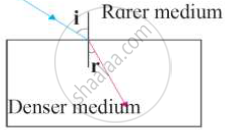
Observe the figure and write accurate conclusion regarding refraction of light.
Complete the ray diagram showing its emergence into the air after passing through the prism.

