Advertisements
Advertisements
Question
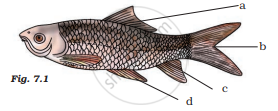
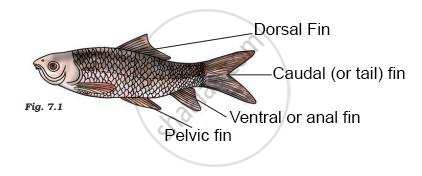
Label a,b,c and d. given in Fig. 7.1 Give the function of (b)
Advertisements
Solution
APPEARS IN
RELATED QUESTIONS
Find the odd one out. Give reason.
sea urchin, starfish, brittle star, jellyfish
Observe the figure and answer the questions given below.
a) To which phylum these organisms belong?
b) Name the substance with which their body is covered.
c) Name their organs of locomotion.

Amphibians do not have the following
Corals are
______ has smallest number of organisms with maximum number of similar characters
Order is a number of related families having common characters placed in an order.
Identity the incorrect statement:
The taxonomic unit ‘Phylum’ in the classification of animals is equivalent to which hierarchical level in classification of plants.
International Code of Botanical Nomenclature (ICBN) has provided a code for classification of plants. Give hierarchy of units of classification botanists follow while classifying plants and mention different ‘Suffixes’ used for the units.
Define a taxon. What is meant by taxonomic hierarchy. Give a flow diagram from the lowest to highest category for a plant and an animal. What happens to the number of individuals and number of shared characters as we go up the taxonomical hierarchy?
