Advertisements
Advertisements
Question
Is the acceleration due to gravity of earth ‘g’ a constant ? Discuss.
Advertisements
Solution
No, the value of acceleration due to gravity (g) is not constant at all the places on the surface of the earth. Since the radius of the earth is minimum at the poles and maximum at the equator, the value of g is maximum at the poles and minimum at the equator. As we go up from the surface of the earth, the distance from the centre of the earth increases and hence the value of g decreases. The value of g also decreases as we go down inside the earth.
APPEARS IN
RELATED QUESTIONS
What is the value of gravitational constant G (i) on the earth, and (ii) on the moon ?
An object takes 5 s to reach the ground from a height of 5 m on a planet. What is the value of g on the planet?
The mass of the moon is `1/81` of the mass of the earth. Its diameter is `1/3.7` of that of the earth. If acceleration due to gravity on the surface of the earth is 9.8 m/s2, then the acceleration due to gravity on the surface of the moon.
The acceleration due to gravity on a planet is 1.96 m/s2. If it is safe to jump from a height of 3 m on tbe earth, the corresponding height on the planet will be ____________.
Suppose the gravity of the earth suddenly becomes zero, then in which direction will the moon begin to move if no other celestial body affects it?
How does the force of attraction between the two bodies depend upon their masses and the distance between them? A student thought that two bricks tied together would fall faster than a single one under the action of gravity. Do you agree with his hypothesis or not? Comment.
The value of gravitational acceleration g at a height h above the earth's surface is `"g"/4`, then ______. (R = radius of earth)
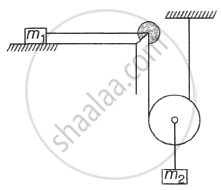
If the surface is smooth, the acceleration of the block m2 will be ______.
A uniform ring of mass M and radius r is placed directly above a uniform sphere of mass 8M and of same radius R. The centre of the ring is at a distance of d = `sqrt3`R from the centre of the sphere. The gravitational attraction between the sphere and the ring is ______.
Where on Earth is the value of acceleration due to gravity the highest?
