Advertisements
Advertisements
Question
In the given Figure, if AB = 2, BC = 6, AE = 6, BF = 8, CE = 7, and CF = 7, compute the ratio of the area of quadrilateral ABDE to the area of ΔCDF. (Use congruent property of triangles)
Advertisements
Solution
Given: AB = 2 cm, BC = 6 cm, AE = 6 cm, BF = 8 cm, CE = 7 cm and CF = 7 cm
Consider ΔAEC and ΔBCF.
In ΔAEC, AE = 6 cm, EC = 7 cm and AC = 8 cm (2 + 6 = 8)
In ΔBCF, BC = 6 cm, CF = 7 cm and BF = 8 cm
∴ ΔAEC ≅ ΔBCF
∴ Area of ΔAEC = Area of ΔBCF ...(Two triangles are similar areas are equal)
Subtract area of ΔBDC on both sides we get,
Area of ΔAEC – Area of ΔBDC = Area of ΔBCF – Area of ΔBDC
Area of quadrilateral ABDE = Area of ΔCDF
APPEARS IN
RELATED QUESTIONS
In a parallelogram ABCD, determine the sum of angles ∠C and ∠D .
In a parallelogram ABCD, if `∠`B = 135°, determine the measures of its other angles .
The sides AB and CD of a parallelogram ABCD are bisected at E and F. Prove that EBFD is a parallelogram.
P and Q are the points of trisection of the diagonal BD of a parallelogram AB Prove that CQ is parallel to AP. Prove also that AC bisects PQ.
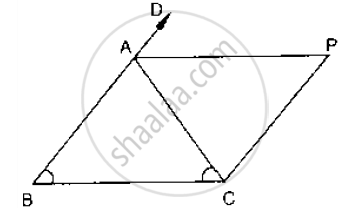
In Fig. below, AB = AC and CP || BA and AP is the bisector of exterior ∠CAD of ΔABC.
Prove that (i) ∠PAC = ∠BCA (ii) ABCP is a parallelogram
In a parallelogram ABCD, if ∠D = 115°, then write the measure of ∠A.
We get a rhombus by joining the mid-points of the sides of a
The figure formed by joining the mid-points of the adjacent sides of a parallelogram is a
ABCD is a square, diagonals AC and BD meet at O. The number of pairs of congruent triangles with vertex O are
Prove that the quadrilateral formed by the bisectors of the angles of a parallelogram is a rectangle.
