Advertisements
Advertisements
Question
In the given diagram, shade the region which represents the set given underneath the diagrams: (P ∩ Q)'
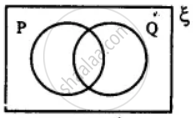
Advertisements
Solution
(P ∪ Q)' = 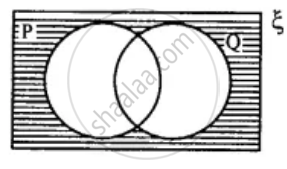
APPEARS IN
RELATED QUESTIONS
Express the truth of each of the following statements by Venn diagram:
(a) Some hardworking students are obedient.
(b) No circles are polygons.
(c) All teachers are scholars and scholars are teachers.
If A and B are two set such that \[A \subset B\]then find:
\[A \cap B\]
Let A = {3, 6, 12, 15, 18, 21}, B = {4, 8, 12, 16, 20}, C = {2, 4, 6, 8, 10, 12, 14, 16} and D = {5, 10, 15, 20}. Find: \[C - A\]
Using the Venn diagram, examine the logical equivalence of the following statements:
(a) Some politicians are actors.
(b) There are politicians who are actors.
(c) There are politicians who are not actors.
Express the truth of each of the following statements using Venn diagram.
(1) All teachers are scholars and scholars are teachers.
(2) If a quadrilateral is a rhombus then it is a parallelogram..
From the given diagram find :
(A ∪ B)'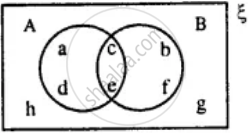
Use the given Venn-diagram to find:
B - A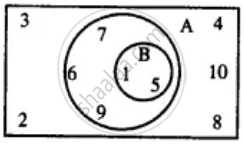
Draw a Venn-diagram to show the relationship between two overlapping sets A and B. Now shade the region representing :
A ∪ B
Draw a Venn-diagram to show the relationship between two sets A and B; such that A ⊆ B, Now shade the region representing :
A ∪ B
Express the truth of the following statement by the Venn diagram.
All men are mortal.
