Advertisements
Advertisements
Question
In the following figure, which pairs of triangles are congruent by SAS congruence criterion (condition)? if congruent, write the congruence of the two triangles in symbolic form.

Advertisements
Solution
In ∆SUT and ∆XYZ,
ST = XZ = 3 cm ...(Given)
UT = YZ = 4 cm ...(Given)
∠STU = ∠XZY = 30° ...(Given)
∴ ∆SUT ≅ ∆XYZ ...(SAS criterion)
APPEARS IN
RELATED QUESTIONS
State whether the two triangles are congruent or not. Justify your answer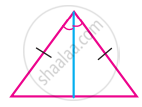
To conclude the congruency of triangles, mark the required information in the following figure with reference to the given congruency criterion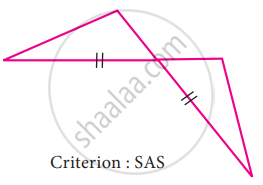
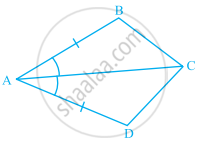
In the following figure, AB = AD and ∠BAC = ∠DAC. Then
- ∆ ______ ≅ ∆ABC.
- BC = ______.
- ∠BCA = ______.
- Line segment AC bisects ______ and ______.
In the following figure, which pairs of triangles are congruent by SAS congruence criterion (condition)? if congruent, write the congruence of the two triangles in symbolic form.

In the following figure, which pairs of triangles are congruent by SAS congruence criterion (condition)? if congruent, write the congruence of the two triangles in symbolic form.

In the following figure, which pairs of triangles are congruent by SAS congruence criterion (condition)? if congruent, write the congruence of the two triangles in symbolic form.

In the following figure, which pairs of triangles are congruent by SAS congruence criterion (condition)? if congruent, write the congruence of the two triangles in symbolic form.

In the following figure, which pairs of triangles are congruent by SAS congruence criterion (condition)? if congruent, write the congruence of the two triangles in symbolic form.

State which of the following pairs of triangles are congruent. If yes, write them in symbolic form (you may draw a rough figure).
∆PQR: PQ = 3.5 cm, QR = 4.0 cm, ∠Q = 60°
∆STU: ST = 3.5 cm, TU = 4 cm, ∠T = 60°
In the following figure, DE = IH, EG = FI and ∠E = ∠I. Is ∆DEF ≅ ∆HIG? If yes, by which congruence criterion?

